
Houston Stadium opened its World Cup 2026 on June 14: Germany against Curaçao, noon kickoff, 93-degree heat outside and 72-degree air conditioning inside. The question every international fan asked before flying in was whether they needed to rent a car. They did not. Houston is car-dependent by reputation, but the METRORail Red Line runs a direct corridor from Downtown to NRG Stadium, and during the tournament METRO ran trains every 6 minutes, per METRO’s own service notice. A hotel along that corridor put the whole trip on a $3 day pass and a pair of walking shoes. These are the four neighborhoods that worked without a rental car, and the Red Line still runs the same route.
- METRO's expanded service window ran June 7 through July 11. Red Line trains arrived every 6 minutes from roughly 5 a.m. to 1 a.m.
- Fannin South Park & Ride charged $50 per vehicle on match days. That covered round-trip rail for everyone in the car, and the lot took credit or debit only. The budget alternative was free parking at West Loop Transit Center plus a $2 Route 211 connector to the stadium.
- NRG lots sold zero day-of parking. Every space was pre-purchase.
- The Fan Festival in EaDo ran June 11 to July 19: free entry, gates 90 minutes before the day's first kickoff.
Houston’s 7 Matches: Dates, Teams, and Why Timing Mattered
Houston Stadium (NRG Stadium’s tournament name) hosted seven matches from June 14 through July 4: five group-stage games and two knockout rounds. The draw landed Houston some heavy hitters. Germany, Portugal (twice), and the Netherlands all played here.
| Date | Match | Kickoff (CT) |
|---|---|---|
| Sun, June 14 | Germany vs Curaçao | 12:00 PM |
| Wed, June 17 | Portugal vs Congo DR | 12:00 PM |
| Sat, June 20 | Netherlands vs Sweden | 12:00 PM |
| Tue, June 23 | Portugal vs Uzbekistan | 12:00 PM |
| Fri, June 26 | Cabo Verde vs Saudi Arabia | 7:00 PM |
| Mon, June 29 | Round of 32 | 12:00 PM |
| Sat, July 4 | Round of 16 | 12:00 PM |
Six of seven matches kicked off at noon. A 9:00 AM boarding on the Red Line had you back at your hotel by 4:00 PM with the entire evening free. That noon schedule was a gift for car-free visitors: daytime transit when trains ran most frequently, and no late-night rideshare surge. The one exception was the June 26 evening match (7:00 PM CT), after which METRO’s extended late-night service ran every 12 minutes.
For the full match-by-match breakdown, see the official Houston match schedule on the host committee site, or the Houston World Cup 2026 hub page for the team fan guides.
The Red Line Did the Whole Job — Here’s How It Worked
The METRORail Red Line was the spine of a car-free World Cup trip. It runs 13 miles from Northline Transit Center through Downtown, Midtown, the Museum District, and the Texas Medical Center, terminating at NRG Park right at the stadium gates. During the tournament window (June 7 through July 11), METRO ran Red Line trains every 6 minutes all day, with extended late-night service every 12 minutes after evening matches.
The Fan Festival sat in EaDo (East Downtown), which is on the Green and Purple Lines, not the Red Line. Getting from the Fan Fest to the stadium meant riding the Green or Purple Line to Main Street Square station in Downtown, then transferring to the Red Line heading south: about 25 minutes including the transfer, and considerably longer on match days when the platforms were packed.
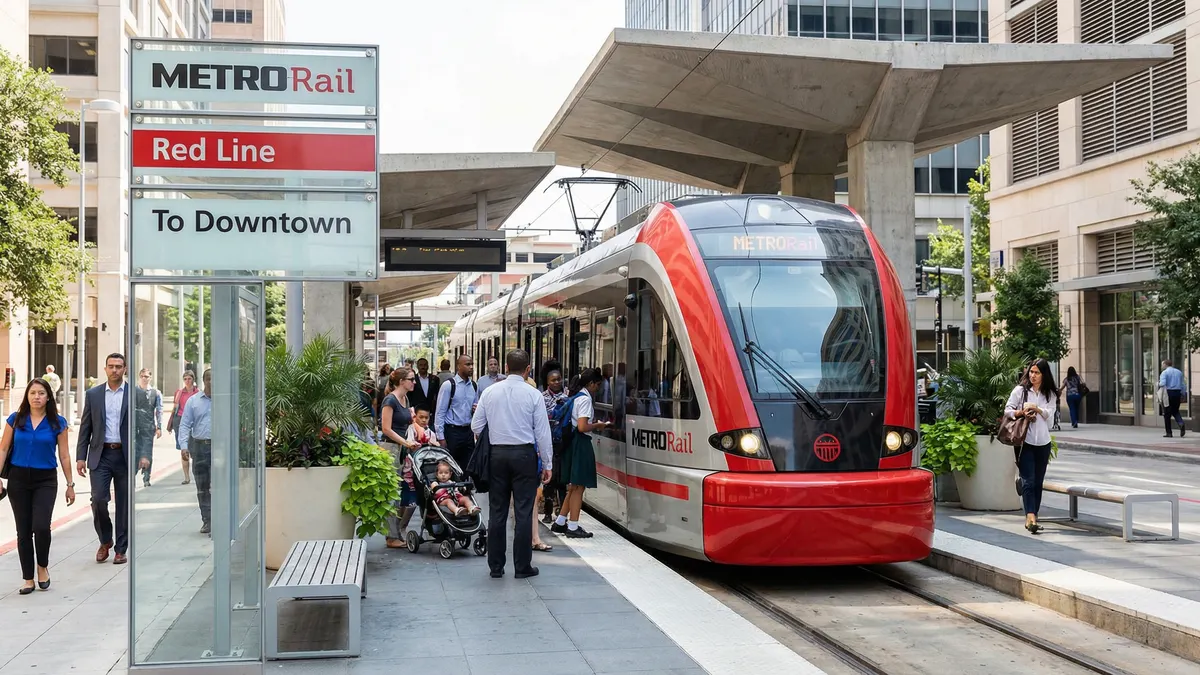
The tournament also gave Houston a deadline for the Green Corridor, a 14-mile pedestrian-and-bike spine connecting EaDo, Downtown, Midtown, and the Museum District through shaded trails, solar-lit paths, and a 7-block pedestrian-only zone on Main Street downtown. It was scoped as a permanent addition rather than a tournament pop-up. For European and South American fans used to walkable cities, the Green Corridor is the closest Houston gets to that experience.
For the complete transit breakdown including METRO maps and match-day timelines, see the METRO official site or our full Houston World Cup transportation guide.
The 4 Neighborhoods That Worked Without a Car
Not every Houston neighborhood works without wheels. These four did, ranked by how the car-free logistics actually played out during the tournament, not by hotel star ratings.
Museum District — Closest to the Stadium, Quietest Between Matches
The Museum District is 13 minutes from NRG Stadium on the Red Line. That is the shortest rail ride of any neighborhood with real hotels, restaurants, and things to do between matches. Hermann Park, the Houston Zoo, the Museum of Fine Arts, and the Menil Collection are all walkable. The area scores a 74 Walk Score with most errands doable on foot.
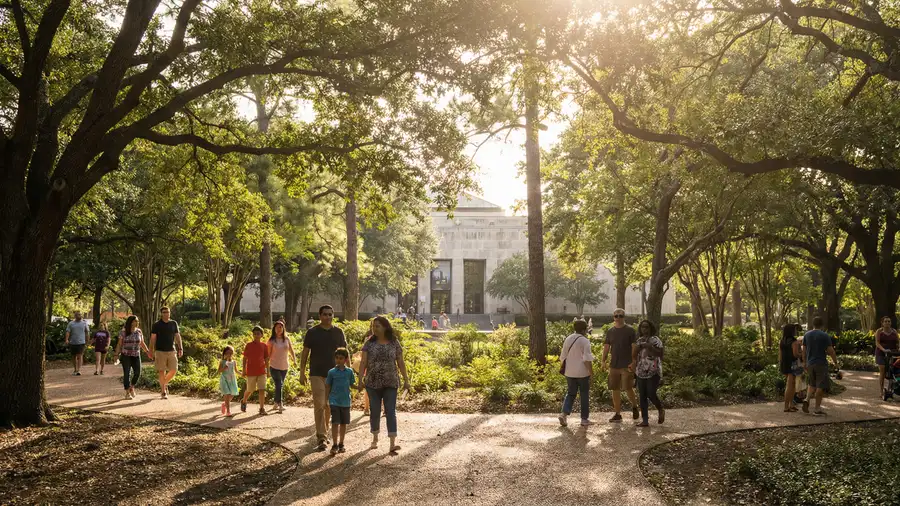
Hotel ZaZa Houston (5701 Main Street) sits within walking distance of both the Red Line and the museum cluster; tournament rates ran $200–$600 a night. The Courtyard by Marriott Houston Medical Center was the mid-range alternative at $150–$300 a night with the same Red Line access.
Not for you if: You want late-night bars and noise. The Museum District is quiet after 10 PM. For nightlife, Midtown is one Red Line stop north.
Midtown — Best Nightlife and the Strongest Walk Score on the Rail
Midtown is Houston’s strongest car-free neighborhood, full stop. Walk Score of 86, Transit Score of 75, and you can reach eight restaurants, bars, or coffee shops within a five-minute walk in any direction. The Red Line runs right through it: 19 minutes to NRG Stadium.
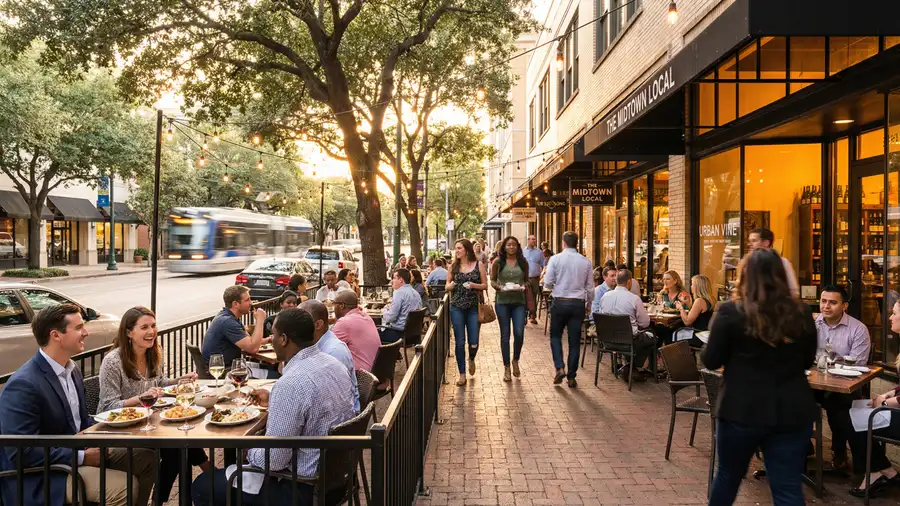
This was the neighborhood for groups of friends, younger fans, and anyone who wanted the post-match party without a rideshare bill. Residence Inn Houston Midtown ran $150 to $250 per night with solid Red Line access. The area was also allocated $1.5 million in World Cup beautification from the host committee: 80 new trees, water stations, crosswalk improvements, and public art along the Red Line corridor.
For furnished short-term stays in Midtown, month-to-month leases offer better value than hotels for trips longer than a week.
Not for you if: You need quiet evenings or you’re traveling with young kids. Midtown gets loud on weekends.
Downtown — Central Hub, Best for First-Time Houston Visitors
Downtown Houston scores a 78 Walk Score and puts you at the center of everything: Discovery Green park, the Theater District, the underground tunnel system (air-conditioned, which matters in June), and a direct Red Line ride to NRG in 21 minutes. The Main Street Promenade, seven blocks of pedestrian-only space with shade structures right along the Red Line, was scheduled to open in May 2026, just ahead of the tournament.
Hotels ran $180–$400/night. The Marriott Marquis Houston is the anchor property with a rooftop lazy river and direct Red Line access. Downtown was also the transfer hub for reaching EaDo’s Fan Festival on the Green and Purple Lines.
The Houston World Cup restaurant and bar guide covers dining options across all four neighborhoods.
Not for you if: You want neighborhood charm. Downtown Houston has a corporate-district feel on weekdays and empties out after office hours. It fills up during the tournament, but the atmosphere is more “hotel lobby” than “local hangout.”
EaDo — Steps from the Fan Festival, One Transfer from the Matches
East Downtown is where the official FIFA Fan Festival was staged. For fans whose main goal was atmosphere (street art, breweries, food trucks, live music screenings), EaDo was the place. Walk Score is 72 and climbing as new restaurants and bars keep opening along Navigation Boulevard.
EaDo sits on the Green and Purple Lines, not the Red Line. Getting to NRG Stadium required a transfer at Main Street Square station in Downtown. Total transit time: about 25 minutes plus transfer waiting. That extra step was the only downside.
Hotels are cheaper here ($120–$200/night), and Airbnb/VRBO options are more common than in Midtown or the Museum District. EaDo is also the closest neighborhood to Minute Maid Park, which made an Astros game an easy filler between matches.
Not for you if: You want a short, direct ride to the stadium. The EaDo-to-NRG transfer adds unpredictability, and on match days the connection could take 30 to 40 minutes.
| Neighborhood | Red Line to NRG | Walk Score | Hotel Range | Best For |
|---|---|---|---|---|
| Museum District | 13 min | 74 | $200–$600 | Closest to stadium, culture lovers |
| Midtown | 19 min | 86 | $150–$250 | Nightlife, groups, walkability |
| Downtown | 21 min | 78 | $180–$400 | First-timers, central access |
| EaDo | 25 min* | 72 | $120–$200 | Fan Festival, budget-friendly |
*EaDo requires a Green/Purple → Red Line transfer. All other times are direct Red Line rides, plus a 10-minute walk from Stadium Park / Astrodome station to NRG gates.
Getting from the Airport to Your Hotel Without a Car
Two airports serve Houston: George Bush Intercontinental (IAH) and William P. Hobby (HOU). Neither connects directly to METRORail, but both have workable car-free options.
From IAH (most international flights): METRO Route 500 Downtown Direct runs to Downtown for $4.50 and takes about 60 minutes. During the World Cup, METRO added shuttle service every 30 minutes with three Downtown hotel stops. For late arrivals or door-to-door service, rideshare runs $35 to $55 to the inner loop.
From HOU/Hobby (Southwest hub, closer to NRG): As of February 2026, METRO Route 500 now also serves Hobby Airport, running direct to Downtown for $4.50. Total trip to Downtown: about 45 minutes. Rideshare from Hobby to Midtown or the Museum District runs $20 to $35.
For the full arrival-day checklist including what to pack for Houston’s June heat, see the Houston World Cup survival guide.
What Doesn’t Work Without a Car in Houston
Houston is 665 square miles. The Red Line covers 13 of them. Here is what is off-limits without wheels.
The Heights: Walk Score of 75, great restaurants and vintage shops, but zero rail access. It meant a rideshare for every match day, every Fan Festival visit, and every night out elsewhere. A poor base for a World Cup trip.
Galleria / Uptown: Luxury hotels, upscale shopping, no METRORail. A rideshare to NRG Stadium runs $25 to $40 each way in normal conditions, and match days carried surge pricing on top. Not worth the hassle unless someone else was driving.
Sugar Land and suburbs: Hotels are 40–60% cheaper, but you’re 25 miles from NRG with no rail connection, so every match day meant a surge-priced ride in each direction.
NASA Space Center: 30 miles southeast, no transit. Rideshare runs $50+ each way. If it’s on your bucket list, book a guided tour that includes transport or rent a car for that one day.
City buses: METRO buses exist, but headways are 20 to 30 minutes, stops lack shade, and June in Houston averages 93°F with high humidity. Standing at a bus stop in that heat is not a plan. It’s a punishment.
Bikeshare: Houston’s BCycle bikeshare program shut down in 2024, so there was no public bike rental system available during the tournament.
Budget Breakdown: What a Car-Free World Cup Trip Cost Per Day
The transit savings were real. Fans who used the Red Line spent $3 a day getting around. Fans who didn’t paid rideshare rates for every trip, surge included on match days.
| Expense | Budget | Mid-Range | Premium |
|---|---|---|---|
| Hotel (per night) | $120–$150 | $200–$300 | $400–$600 |
| Transit (METRO day pass) | $3 | $3 | $3 |
| Food & drink | $40–$60 | $80–$120 | $150+ |
| Match ticket (Cat 3–Cat 1) | $50–$80 | $150–$250 | $400+ |
| Daily total | $213–$293 | $433–$673 | $953+ |
Houston was the most affordable U.S. host city for hotels, averaging $146 per night against $583 in New York, according to Lighthouse hotel data. Match-day rates did spike (KHOU reported one room jumping from $133 to over $1,200 after the draw), but mid-range rooms on the Red Line stayed in the $150 to $250 range for anyone who booked early.
Frequently Asked Questions
Were Uber and Lyft reliable during World Cup matches in Houston?
Between matches, yes — Houston has strong rideshare coverage inside the loop. Near NRG Stadium on match days it was subject to surge pricing in the 90 minutes before kickoff and again after the final whistle, so the Red Line at $1.25 was the faster and cheaper option. Rideshare made sense for off-peak trips to neighborhoods without rail access.
How much does a METRO day pass cost in Houston?
A day pass costs $3 and covers unlimited rides on all three METRORail lines (Red, Green, Purple) plus all local buses for the full calendar day. Single rides are $1.25 each. You can tap any contactless credit card, Apple Pay, or Google Pay directly at the platform validator. Physical RideMETRO cards cost $2 at kiosks if you prefer one, but they are not required.
Can you walk from the Museum District to NRG Stadium?
Technically yes, about 2 miles and 40 minutes on foot along Main Street. The sidewalk is flat and the route is straightforward. But in June, Houston averages 93°F with heavy humidity, and you’ll arrive drenched. The Red Line covers the same distance in 13 air-conditioned minutes for $1.25. Walk it post-match to avoid the station crowd; skip it pre-match when you need to arrive fresh.
Was it better to stay near NRG Stadium or downtown for the World Cup?
Midtown. It split the difference: 19 minutes to NRG on the Red Line, walkable nightlife and food, and easy Green Line access to the EaDo Fan Festival. For a single-match trip, the Museum District sat closer to the stadium (13 minutes). For a pure nightlife trip, EaDo put you at the Fan Fest. But for fans attending two or three matches over a week, Midtown was the strongest all-around pick.
Was Houston safe to walk around at night during the World Cup?
Downtown, Midtown, the Museum District, and EaDo are all reasonably safe for nighttime walking, and during the tournament METRO put 55 additional police officers a day on transit routes. Standard big-city awareness applies: stick to well-lit streets, avoid isolated blocks after midnight, and travel in groups late at night.
Do I need a car to visit NASA Space Center from Houston?
Yes. Space Center Houston is 30 miles southeast of the inner loop with no METRORail connection. Rideshare costs $50 or more each way. Your best option is a guided tour that includes round-trip transport — several depart daily from Downtown. If NASA is a must-do, rent a car for that one day and use METRO for everything else.
For World Cup visitors who flew in without a car, Midtown was the answer. Best Walk Score on the rail line, best nightlife within walking distance, and a 19-minute direct ride to NRG Stadium. The Museum District won on stadium proximity, and EaDo won on Fan Festival energy. But Midtown was where the car-free math worked best day after day, and that is still true of the Red Line corridor between events. For the full neighborhood breakdown with hotel picks, see the complete Houston World Cup where-to-stay guide.