
Dallas vs Austin comes down to money against lifestyle: Dallas is about $101,000 cheaper on median sale price (city median sale price, Redfin, Aug 2026) and has eight times as many Fortune 500 companies, while Austin earns 21.7% more per household and has less violent crime. The two sit three hours apart on I-35 and share the same tax code (zero state income tax, 8.25% sales tax). Those gaps, plus two completely different cultural identities, make this a real decision, not a coin flip. Every number in this guide uses same-source, same-date data so the comparison is apples to apples.
The Two Cities at a Glance: 2026 Quick Comparison
| Category | Dallas | Austin | Source |
|---|---|---|---|
| City Population | 1,326,093 | 993,771 | Census ACS 2024 |
| Metro Population | 8,344,032 | 2,550,637 | Census March 2025 |
| Median Home Price | $448,703 | $549,636 | Redfin, city median sale price, Aug 2026 |
| Avg 1BR Rent | $1,355/mo | $1,566/mo | Zumper April 2026 |
| Avg 2BR Rent | $1,816/mo | $2,025/mo | Zumper April 2026 |
| Median HH Income | $74,323 | $90,430 | Census ACS 2024 |
| Unemployment (not seasonally adjusted) | 4.7% | 4.1% | BLS Local Area Unemployment Statistics, June 2026 |
| Property Tax (combined, pre-exemption) | ~2.23% | ~2.05% | Dallas County Tax Office; City of Austin + Austin ISD + Travis County + ACC + Central Health, 2025 |
| Fortune 500 HQs | 24 | 3 | Fortune 2026 |
| Violent Crime (per 100K) | 658–778 | ~467 | FBI UCR 2024 |
| Walk Score | 46 | 42 | WalkScore.com 2026 |
| Avg Commute | 26.8 min | 24.2 min | Census ACS 2024 |
| Nonstop Flights (Airport) | 271 (DFW) | ~102 (AUS) | DFW Airport (Apr 2026) / KUT 2025 |
For the deep dive on Dallas alone, see our honest Dallas 2026 assessment. For the side-by-side numbers from Austin’s side, see the Austin vs Dallas stats.
Sponsored: RelocateMeTX is affiliated with F.A.D Furnished Apartments.
Housing Costs: The $101,000 Gap
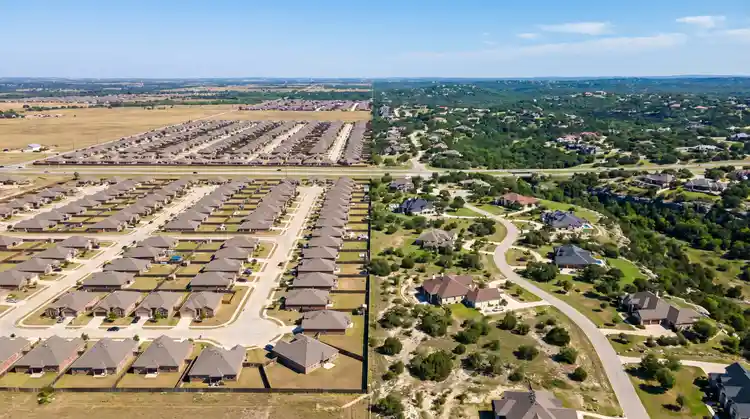
This is where the decision starts for most people. Dallas’s median home sale price is $448,703 (City of Dallas, Redfin, August 2026). Austin’s is $549,636 (City of Austin, Redfin, August 2026). That’s a $100,933 difference on the same data source, same month, with Dallas about 18% lower. Not a rounding error. And Austin prices are still easing: inside the City of Austin the August 2026 median was down 4.3% from a year earlier (Unlock MLS, the Austin Board of REALTORS® MLS).
On rent, the gap is smaller but consistent: $1,355/mo for a Dallas 1BR vs. $1,566/mo in Austin (Zumper, April 2026). That’s $211/mo or $2,532/yr. For a 2BR, it’s $1,816 vs. $2,025, a $209/mo difference.
But here’s what the headline numbers miss: Dallas property taxes run ~2.23% combined before exemptions (city of Dallas; suburbs with MUD/PID higher), while Austin’s is about 2.05% combined, before exemptions (City of Austin + Austin ISD + Travis County + ACC + Central Health, 2025). On a $448,703 Dallas home, that’s about $9,991/yr before exemptions, while a $549,636 Austin home at about 2.05% runs about $11,248/yr, so the higher Austin home value more than offsets its lower rate and the Austin bill comes out about $1,257 higher. Dallas’s $140,000 homestead exemption (SB 4, 2025) lowers a new owner’s effective rate to ~1.58–1.74%. For the full property tax breakdown by DFW neighborhood, see our Dallas cost of living by neighborhood guide.
Cost of Living: Why the Index Numbers Disagree
You’ll find wildly different cost-of-living comparisons depending on which source you check. Here’s why.
C2ER (Council for Community and Economic Research) puts Dallas at about 101.7 and Austin at 97.4. By that measure, Austin is actually cheaper. C2ER weights professional salary benchmarks heavily, and Austin’s higher incomes pull the index down relative to costs.
BestPlaces tells the opposite story: Dallas at roughly 100 (national average) and Austin at 129. BestPlaces leans hard on housing costs, and Austin’s $550K median sale price (Redfin, Aug 2026) dominates the calculation.
Which one’s right? Both, depending on what you care about. If you’re comparing your salary’s purchasing power, C2ER is more relevant. If you’re asking “what will it cost me to buy a house,” BestPlaces is closer to reality. We use C2ER as the baseline because it’s the standard among relocation economists, but we flag the BestPlaces numbers wherever housing dominates the decision.
Jobs and Income: Which City Pays More?
Austin pays more. That’s the short answer. Austin’s median household income is $90,430 vs. Dallas’s $74,323 (Census ACS 2024). Per capita income is even more dramatic: $66,973 in Austin vs. $46,605 in Dallas. On unemployment the two metros bracket the national figure: Austin was at 4.1% and Dallas-Fort Worth at 4.7% in June 2026, against 4.4% for the U.S. on the same not-seasonally-adjusted basis (BLS Local Area Unemployment Statistics).
But income doesn’t exist in a vacuum. Austin’s 21.7% higher household income buys housing that costs about 22% more (city median sale price, Redfin, Aug 2026). Dallas offers a better ratio of income to housing cost for most earners outside tech. The metro-level numbers close the gap somewhat: DFW metro median household income is $92,733 vs. Austin metro’s $99,897.
The math favors Dallas for: corporate roles, finance, healthcare, logistics, defense, and anyone earning a set salary they can relocate with. Austin wins for: roles where the job itself pays more there, primarily tech and startup equity positions.
Fortune 500 Companies: 24 vs. 3
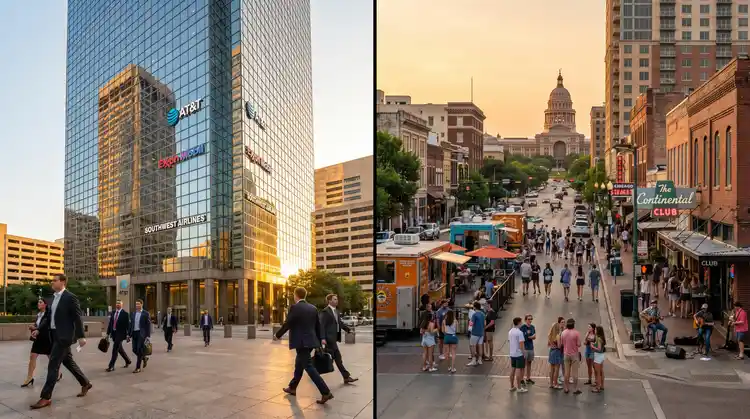
This is the stat competitors miss. Dallas-Fort Worth has 24 companies on the 2026 Fortune 500 list, per CultureMap Dallas. The Austin area has 3 (Dell, Tesla and Oracle), per the Austin American-Statesman. That’s not a rounding error. It’s a structural difference in the kinds of careers each city supports.
DFW’s roster includes AT&T, Southwest Airlines, American Airlines, Texas Instruments, Energy Transfer, Kimberly-Clark, McKesson, Tenet Healthcare, and Celanese, among others. These aren’t just employers. They’re entire ecosystems of supplier contracts, professional services firms, and career ladders that don’t exist in Austin.
Austin’s economy tilts toward tech startups, mid-size SaaS companies, and the state government. The University of Texas at Austin is one of the city’s anchor employers. Tesla’s Gigafactory sits in southeast Austin, Dell’s headquarters in Round Rock, and Samsung’s fab in northeast Austin counts 4,500 employees by Samsung’s own campus page (2026).
If you want corporate stability with a clear promotion track at a large enterprise, DFW has 10 times the options. If you want startup energy and equity upside, Austin’s the play.
Crime and Safety: Which City Is Safer?
Austin. Not close. Austin’s violent crime rate sits around 467 per 100,000 residents (FBI UCR 2024). Dallas reports 658–778 per 100,000 depending on reporting methodology — a 30%+ gap.
Some context helps here. Dallas saw an 8.2% drop in violent crime during 2024 and recorded 183 homicides. Austin reported 55 homicides in the same period. Both cities are trending in the right direction, but the baseline difference is significant.
Property crime tells a similar story. Austin isn’t immune to theft and car break-ins (no Texas city is), but the violent-crime figures above put its overall safety profile ahead. For families with young kids, this gap matters more than most of the other numbers on this page.
Getting Around: Traffic, Transit, and Commutes
Both cities are car-dependent. No getting around that. Dallas scores a 46 Walk Score, Austin a 42. Neither will remind you of Chicago or New York.
Dallas has a meaningful advantage in public transit: DART (Dallas Area Rapid Transit) runs 93 miles of light rail, the longest light rail system in the U.S. by track length. Austin’s CapMetro runs buses and a single commuter rail line. Project Connect, Austin’s planned light rail system, won’t open its first 15 stations until 2033. Today, 30.7% of Austin workers work from home (Census ACS 2024), which helps explain the shorter average commute of 24.2 minutes vs. Dallas’s 26.8.
Bike Score goes to Austin (54 vs. 49). If cycling is part of your commute, Austin has more dedicated infrastructure.
Schools: Which Metro Has the Best Districts?
Both metros have excellent suburban school districts. This one’s a draw on quality, with DFW winning on volume.
DFW’s top-rated districts include Highland Park ISD, Coppell ISD, Carroll ISD (Southlake), Lovejoy ISD, and Frisco ISD. All carry A ratings from TEA. The advantage: with 9,000+ square miles of metro area, DFW offers more neighborhoods where strong schools intersect with affordable housing.
Austin’s standouts include Eanes ISD, Round Rock ISD, Leander ISD, and Dripping Springs ISD, though homes inside Eanes’s boundaries start well above $800K.
If school quality is your deciding factor, both cities deliver. But if school quality plus affordability matters, DFW’s wider selection of A-rated districts in the $400K–$600K home price range gives it an edge.
Weather: Summer Heat, Tornado Risk, and Ice Storms
Summers are virtually identical. Both cities average 95–96°F in July. Your car AC will run the first ten minutes of every drive from May through October regardless of which city you pick.
Where they diverge: Dallas gets more annual rainfall (39.1 inches vs. 34.9), sits squarely in tornado alley with meaningful risk from March through May, and catches 1–2 ice storms per winter. Austin has lower tornado risk but higher flash flood danger during spring storms. Austin also gets slightly less severe winter weather, though the February 2021 freeze proved that neither city is immune.
For weather preferences, Austin is mildly better if you dislike ice and tornado watches. Dallas is mildly better if you dislike flash floods. Neither city offers four true seasons, and both will test your heat tolerance.
Airport Access: Where You Can Fly From Each City
DFW Airport was the fourth-busiest airport in the world by passenger traffic in 2025, per ACI World, with 271 nonstop destinations (193 domestic, 78 international, DFW Airport, April 2026) and a major American Airlines hub. Austin-Bergstrom International (AUS) serves about 102 nonstop destinations across 20 airlines.
If you travel internationally for work, this isn’t close. DFW’s 73 international nonstops vs. Austin’s limited international service means fewer connections and shorter travel days. For domestic travel, both airports cover most major U.S. cities, but DFW’s frequency and competition often deliver better fares.
Dallas also has Love Field (Southwest’s headquarters hub), giving the metro two major airports. Austin has one.
Who Should Move to Dallas vs. Austin
Here’s where data meets real life. Five common mover profiles, with evidence-based recommendations.
Families with Kids
Pick Dallas. The roughly $101,000 gap in median sale price (Redfin, Aug 2026) buys more square footage, a bigger yard, and access to more A-rated school districts in the $400K–$600K range. DFW’s healthcare market is larger and more competitive. The trade-off: Austin is 30%+ safer on violent crime stats and has better outdoor recreation (Lake Austin, Barton Springs, Hill Country trails). If safety is your top concern, Austin deserves the edge. But on pure cost-per-quality-of-life math, Dallas wins for most families.
Young Professionals
It depends on your field. Austin wins for nightlife (250+ live music venues, SXSW, ACL), younger median age, and tech culture. Dallas wins for corporate career paths (the deeper Fortune 500 roster), finance, and a lower cost of going out. A $75K salary stretches further in Dallas: $1,355/mo rent vs. $1,566. But if you’re in tech earning $130K+, Austin’s ecosystem and culture may be worth the premium.
Remote Workers
Dallas for value, Austin for lifestyle. If you’re earning a coastal salary and optimizing for savings, Dallas’s lower housing costs put more money in your pocket every month. If your priority is coworking spaces, outdoor access, and a city built around people who also work from home (30.7% WFH rate), Austin has the stronger infrastructure for that lifestyle.
Tech Workers
Austin for startups and SaaS. “Silicon Hills” isn’t marketing. Tech represents 16.3% of Austin’s jobs, and entry-level tech salaries average $128,000–$135,000 vs. Dallas’s $105,000–$114,000. But Austin’s tech market saw hiring declines in 2024 (big tech -1.6%, startups -4.9%), so check current demand before assuming the offer will come.
Dallas for enterprise tech and fintech. Texas Instruments, AT&T, Cisco, Raytheon, Lockheed Martin, and the JPMorgan/Capital One fintech corridor offer stability that startup-heavy Austin can’t match. DFW has roughly 1.5x more total software jobs, mostly at non-tech companies. Lower volatility, lower ceiling.
Retirees
Dallas for practicality. DFW’s larger healthcare system, 271-destination airport, and lower home prices make logistics easier. Austin’s combined property tax rate of about 2.05% before exemptions (City of Austin + Austin ISD + Travis County + ACC + Central Health, 2025) is lower than Dallas’s ~2.23% combined (before exemptions), though the $140,000 homestead exemption narrows that gap for both. Austin is the better pick for active retirees who prioritize hiking, lake access, and a walkable downtown core. Dallas suits retirees who travel frequently and want lower total housing costs.
Frequently Asked Questions
Is it cheaper to live in Dallas or Austin?
Dallas is cheaper on housing: $448,703 median sale price vs. $549,636 in Austin (city median sale price, Redfin, Aug 2026), and $1,355/mo average 1BR rent vs. $1,566 in Austin (Zumper, April 2026). Dallas’s combined rate is higher (~2.23% vs. Austin’s about 2.05% combined, before exemptions, City of Austin + Austin ISD + Travis County + ACC + Central Health, 2025), but because of the home price gap the Dallas bill on the median home is lower: about $9,991 vs. $11,248 a year before exemptions. The $140,000 homestead exemption (SB 4, 2025) further helps Dallas homeowners.
Is Dallas or Austin better for families?
Dallas offers more affordable housing, more A-rated school districts in the $400K–$600K range (Highland Park, Coppell, Carroll, Frisco, Lovejoy ISDs), and a larger healthcare market. Austin is 30%+ safer on violent crime statistics and has superior outdoor recreation. For most families prioritizing space and school quality per dollar, Dallas edges out. For safety-first families, Austin is the stronger pick.
Which city is better for tech jobs?
Austin for pure tech. “Silicon Hills” accounts for 16.3% of Austin’s workforce, with entry-level salaries averaging $128K–$135K vs. Dallas’s $105K–$114K. But DFW has 1.5x more total software jobs (mostly at non-tech enterprises) and offers more stability. Austin saw tech hiring declines in 2024 (-1.6% big tech, -4.9% startups). Dallas is stronger for enterprise tech, fintech, and defense contractors.
Is Austin or Dallas safer?
Austin is significantly safer. Violent crime runs about 467 per 100,000 residents vs. Dallas’s 658–778 per 100,000 (FBI UCR 2024). Both cities saw crime decrease in 2024, but the baseline gap is roughly 30%. Austin reported 55 homicides in 2024 vs. Dallas’s 183.
How far is Austin from Dallas?
About 195 miles via I-35, roughly 3 to 3.5 hours by car depending on traffic. No direct train service currently exists. Both cities have direct flights to each other, but driving is the typical choice for a weekend trip.
Does Dallas have better schools than Austin?
Both metros have top-tier suburban school districts. DFW has more A-rated options (Highland Park, Coppell, Carroll, Frisco, Lovejoy) across a wider price range. Austin’s Eanes ISD is highly regarded, but homes in the district start above $800K. For school quality per dollar spent on housing, DFW has the edge.
Why is Austin more expensive than Dallas?
Austin’s housing boom from 2020–2022 (fueled by tech migration and remote workers) pushed prices well above Dallas despite having a smaller population. The Travis County median peaked at $620,000 in April 2022 before the city-of-Austin median sale price settled at $549,636 (Redfin, August 2026); those are two geographies, so the two numbers describe the direction of the correction rather than a single percentage. Austin also has a tighter land supply (Hill Country geography limits sprawl) and higher demand from tech-salary earners. Dallas can sprawl in every direction, which keeps housing supply more flexible.
Is Dallas or Austin better for young professionals?
Austin wins for nightlife, live music (250+ venues), festivals (SXSW, ACL), and tech startup culture. Dallas wins for corporate career ladders (24 Fortune 500 companies to the Austin area’s 3), lower rent ($211/mo cheaper for a 1BR), and a more diverse industry mix. A $75K salary goes further in Dallas. A $130K+ tech salary fits Austin’s ecosystem better.
Which city has better weather?
Summers are nearly identical (95–96°F highs in July). Dallas gets more rain (39.1 vs. 34.9 inches/year), sits in tornado alley (risk March–May), and averages 1–2 ice storms per winter. Austin has lower tornado risk but higher flash flood danger. Neither city offers four true seasons. Pick based on which natural hazard you prefer to avoid.
What salary do you need to live comfortably in Dallas vs Austin?
SmartAsset’s method (MIT’s living wage doubled under a 50/30/20 budget) gives about $97,000/year for a single person in Dallas County. Austin’s figure runs higher due to the $550K city median sale price (Redfin, Aug 2026) and higher rents, roughly $110,000–$115,000 for equivalent comfort. Dual-income households need approximately $130K–$150K in Dallas and $155K–$175K in Austin. These figures assume renting in a mid-market neighborhood, owning a car, and saving at least 10% of income.