
Austin vs Dallas
Compare Austin and Dallas on tech jobs, housing costs ($460K vs $410K), cost of living, and lifestyle. Same-source 2026 data for relocating professionals.

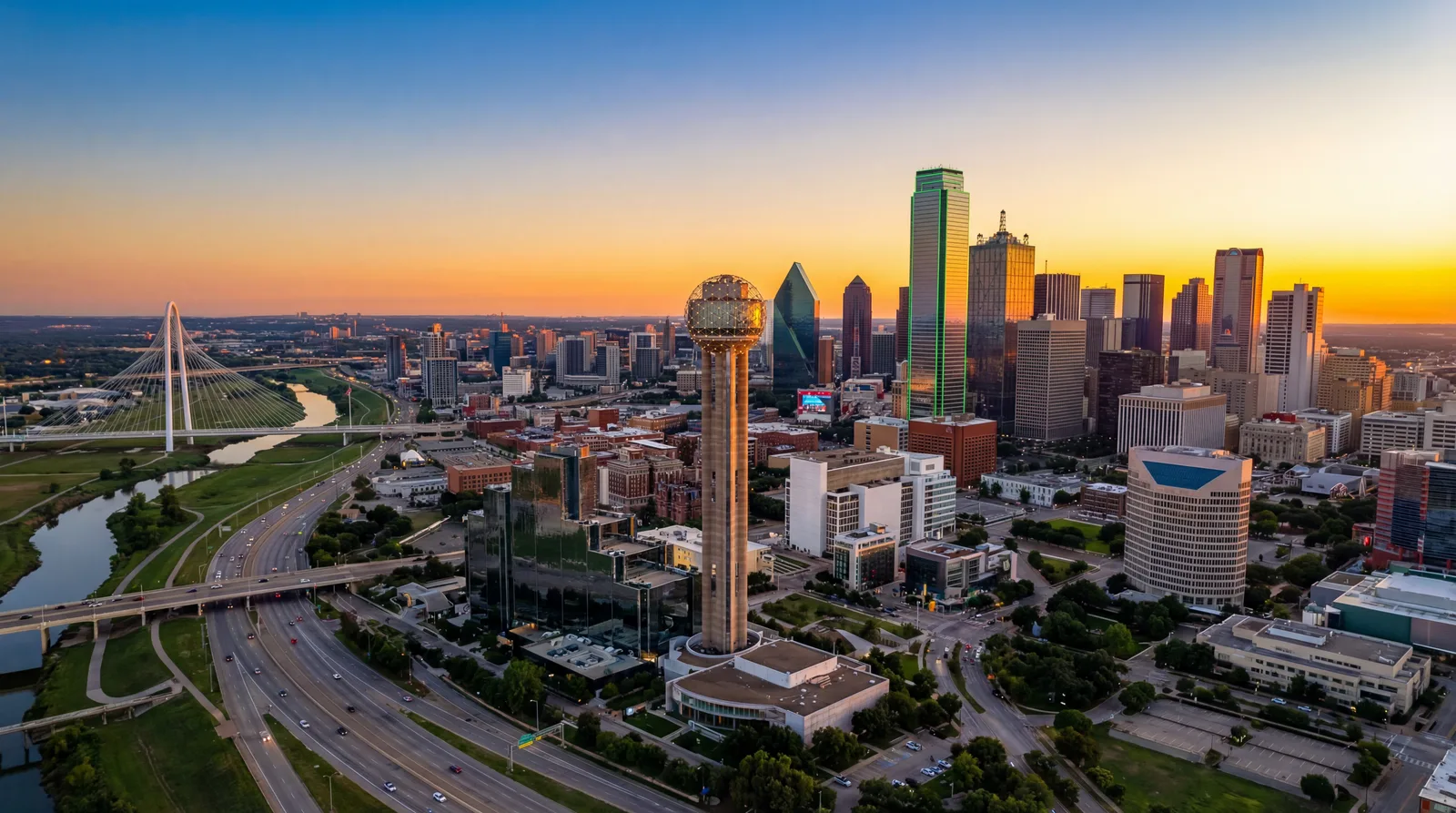 Dallas
 Side-by-Side Metrics
| Category | Austin | Dallas | Winner | Note |
|---|---|---|---|---|
| Median Home Price | $460,000 | $410,000 | Dallas | Dallas is about $50K cheaper at the median |
| Median Rent (1BR) | $1,400 | $1,450 | Austin | Same-source pair: RentCafe, early 2026 (Austin metro 1BR ~$1,400; Dallas 1BR average ~$1,450). Zumper's April 2026 medians ($1,566 Austin, $1,355 Dallas) are a different series and are not mixed into this row. Heavy new apartment supply has pushed Austin rents down. |
| Metro Population | 2.55M | 8.3M+ | Dallas | DFW metro is more than 3x larger |
| Job Growth (Tech) | #1 in Texas | Growing hub | Austin | Austin is Silicon Hills with Tesla, Apple, Google |
| State Income Tax | 0% | 0% | Tie | Both benefit from no Texas income tax |
| Property Tax Rate (combined, pre-exemption) | ~1.8–2.1% | ~2.23% | Austin | City of Dallas stack ~2.23%; an Austin city-limits home runs ~1.8–2.1% depending on school district and MUDs |
| Average Commute Time | 26 min | 30 min | Tie | Both are car-dependent; Austin I-35 bottleneck is worse |
| Walk Score (City Avg) | 42 | 46 | Dallas | Both are car-dependent cities |
| Outdoor Recreation | Hill Country access | Lake recreation | Austin | Barton Springs, Greenbelt, and Hill Country |
| Live Music Venues | 250+ | 100+ | Austin | Austin is the Live Music Capital of the World |
Texas property tax figures above are pre-exemption rates
Texas rates are quoted as combined rates before exemptions — the sum of independently governed taxing units (county, school district, city, hospital, college, and any MUD), so the true total is address-dependent. A Texas homeowner who files for the residence homestead exemption removes $140,000 of taxable value from the school-district portion of the bill only (Tex. Tax Code §11.13(b)). It is not a discount on the whole bill and cannot simply be subtracted from the combined rate.
What it actually saves depends on your own school district's rate — typically $1,400 to $1,800 a year, which takes a statewide combined rate of roughly 1.6–2.5% down to an effective 1.4–1.8% after the exemption (Texas Comptroller — property tax exemptions; Tax Foundation). You must file for it; it is not automatic. Where both cities compared are in Texas, the exemption applies on both sides. Full detail: Texas Property Tax Guide.
Detailed Category Breakdown
Economy & Jobs
Winner: AustinAustin is the undisputed tech capital of Texas. Tesla's Gigafactory, Apple's $1 billion campus, Google, Meta, Oracle's relocated headquarters, Samsung's chip fabrication plant, and hundreds of startups create a concentrated innovation ecosystem that draws comparisons to Silicon Valley. The University of Texas fuels a continuous talent pipeline, and venture capital flows into the city at rates unmatched in the Sun Belt. Dallas counters with scale and diversity: 21 Fortune 500 headquarters span finance, telecommunications, defense, healthcare, and logistics. AT&T, Texas Instruments, Charles Schwab, and American Airlines anchor an economy that is less vulnerable to single-sector downturns. For pure tech careers, startup culture, and innovation-driven roles, Austin leads decisively. For corporate career breadth, industry diversification, and the ability to pivot across sectors without relocating, Dallas provides more options.
Cost of Living
Winner: DallasDallas wins on buying, though the gap is narrower than the reputation suggests. The median home price in DFW sits around $410,000 against Austin's $460,000, roughly 11% cheaper. Renting flips the result: heavy new apartment delivery has pulled Austin's median 1-bedroom to about $1,400 while Dallas sits near $1,450 (both RentCafe, early 2026; Zumper's April 2026 medians run $1,566 and $1,355, a different series). On taxes, a City of Dallas home carries a combined pre-exemption rate near 2.23% versus roughly 1.8–2.1% for an Austin city-limits home, though Austin's higher values narrow the dollar difference. Both cities share zero state income tax, eliminating the biggest financial differentiator that separates Texas from coastal states. Groceries, dining, and general living costs are nearly identical. The practical takeaway: buyers stretch a budget further in DFW suburbs like Frisco, McKinney, and Prosper, while renters currently do slightly better in Austin.
Lifestyle & Culture
Winner: TieAustin and Dallas offer fundamentally different cultural experiences despite being in the same state. Austin is the Live Music Capital of the World with 250+ venues hosting nightly performances, global festivals like SXSW and ACL, a thriving food truck scene, and an ethos that celebrates creativity and individuality. The dress code is casual, the energy is entrepreneurial, and the outdoor lifestyle is central to daily life. Dallas projects a more polished, cosmopolitan energy with world-class museums in the Arts District, upscale dining, professional sports across all major leagues, and a business-forward social culture. Deep Ellum and Bishop Arts provide genuine creative neighborhoods, but the overall vibe skews more professional. Austin attracts people who prioritize lifestyle, creativity, and outdoor access. Dallas attracts people who value career opportunity, cultural sophistication, and suburban family life.
Schools & Families
Winner: DallasDFW holds a clear advantage in the sheer number of top-tier public school districts. Frisco ISD, Carroll ISD, Highland Park ISD, and Coppell ISD are nationally recognized for academic excellence, facilities, and extracurricular programs. The breadth of options means families can find an excellent district at multiple price points. Austin's top districts, Eanes ISD, Lake Travis ISD, and Round Rock ISD, are strong performers and competitive with DFW's best, but there are fewer of them and the associated housing costs are higher. Austin ISD, the city's primary urban district, faces ongoing budget challenges and mixed ratings at some campuses. Both metros offer excellent private school options and proximity to major universities. For families who prioritize public school quality as the primary factor in where to live, DFW's depth of highly rated districts across a wider range of housing budgets is difficult to match.
Transportation
Winner: DallasBoth cities are car-dependent, but they differ in infrastructure and public transit. Dallas operates DART, a 93-mile light rail system connecting downtown to suburbs like Plano, Richardson, and Irving, a genuine commuting alternative for some residents. Austin's Capital MetroRail has limited service on a single commuter line, and Project Connect's light rail expansion is years from operational status. Austin's traffic congestion is notoriously bad relative to its population, with I-35 through downtown ranking among the worst bottlenecks in Texas. Dallas traffic is heavy but distributed across a wider highway network. DFW International Airport is the third-busiest in the world with far more direct routes than Austin-Bergstrom International. One unique Austin advantage: Austin Energy operates as a municipal utility with stable electric rates, while Dallas residents navigate a deregulated electricity market with variable pricing.
Weather & Outdoor Recreation
Winner: AustinWeather is similar but not identical. Both cities experience hot summers with temperatures exceeding 100°F, though Austin's Hill Country elevation provides marginally less humidity than DFW's prairie flatlands. Austin winters are slightly milder, and the city averages about 228 sunny days compared to Dallas's 232. The real differentiator is outdoor recreation, where Austin dominates. Barton Springs Pool, Lady Bird Lake, the Barton Creek Greenbelt, and dozens of Hill Country state parks and swimming holes provide year-round outdoor access that DFW cannot match. Hamilton Pool, Enchanted Rock, Pedernales Falls, and McKinney Falls are all within an hour of downtown Austin. Dallas offers lake recreation at Lewisville, Grapevine, and Ray Hubbard, plus the Trinity Trails system, but the scale and variety of Austin's outdoor offerings are in a different league. Austin does face unique hazards: Cedar Fever allergy season from December through February and serious flash flood risk from its limestone creek system.
Our Verdict
Austin is the stronger choice for tech professionals seeking immersion in Silicon Hills, outdoor enthusiasts drawn to Hill Country recreation, and those who thrive in a creative, music-driven culture with a casual lifestyle. Dallas is the better fit for families prioritizing top-rated suburban school districts, professionals seeking career diversity across 21 Fortune 500 companies, and those who want more affordable housing with superior public transit infrastructure. Both cities share zero state income tax and strong economic growth. Your decision should weigh career focus, lifestyle preferences, and whether you value tech innovation and outdoor access (Austin) or corporate breadth and suburban family infrastructure (Dallas).
Frequently Asked Questions
Is Austin or Dallas better for tech careers?
Austin leads decisively for tech careers. It hosts Tesla's Gigafactory, Apple's $1 billion campus, Google, Meta, Oracle's relocated headquarters, Samsung's chip fabrication plant, and a nationally ranked startup ecosystem. Dallas's tech sector is growing with Texas Instruments, AT&T, and expanding fintech presence, but it remains embedded within a broader corporate economy. If your career is in software engineering, product management, or startup culture, Austin has significantly more opportunities and a stronger professional network.
Is Austin or Dallas more affordable?
It depends on whether you buy or rent. The median home price in DFW is $410,000 compared to Austin's $460,000, so buyers do better in Dallas. Renters currently do slightly better in Austin, where a median 1-bedroom runs about $1,400 against roughly $1,450 in Dallas after a wave of new apartment supply (both RentCafe, early 2026). Neither state taxes income. On property tax, a City of Dallas home carries a combined pre-exemption rate near 2.23% while an Austin city-limits home runs roughly 1.8–2.1% depending on school district and MUDs, though Dallas's lower home values offset part of that. For families seeking maximum value, DFW suburbs like Frisco, McKinney, and Prosper offer new construction in top-rated school districts at prices that are genuinely difficult to find in Austin's competitive market.
Which city has better outdoor recreation?
Austin wins this comparison decisively. Barton Springs Pool, Lady Bird Lake, the Barton Creek Greenbelt, Hamilton Pool, Enchanted Rock, and Pedernales Falls provide swimming, hiking, kayaking, climbing, and camping options that DFW cannot match. Austin's Hill Country setting offers stunning limestone landscapes, spring-fed swimming holes, and scenic cycling routes within 30 minutes of downtown. Dallas has lake recreation and urban trails, but the variety and natural beauty of Austin's outdoor offerings are in a different category.
How far apart are Austin and Dallas?
Austin and Dallas are approximately 195 miles apart, about a 3-hour drive on I-35 through Waco. Multiple daily flights connect the cities in about one hour. The drive is straightforward but I-35 can be congested through Waco and Temple. Many professionals maintain connections in both cities, and weekend visits are common. The cities are close enough for easy travel but far enough to have distinctly different cultures, job markets, and lifestyles.
Which city is better for raising a family?
Dallas has an advantage for families primarily due to its exceptional depth of suburban school districts. Frisco ISD, Carroll ISD, and Highland Park ISD are among the best in the nation, and families can afford spacious new-construction homes in these districts. Austin's Eanes ISD and Lake Travis ISD are excellent but come with higher home prices and fewer options. DFW also offers more master-planned family communities and youth sports infrastructure. Austin appeals to families who prioritize outdoor recreation, cultural exposure, and a more relaxed lifestyle, with Round Rock ISD providing a strong suburban school option.
Explore Austin
Neighborhoods, schools, jobs & more
Explore Dallas
Full relocation guide