How Apartment Locators Get Paid in Houston (2026)
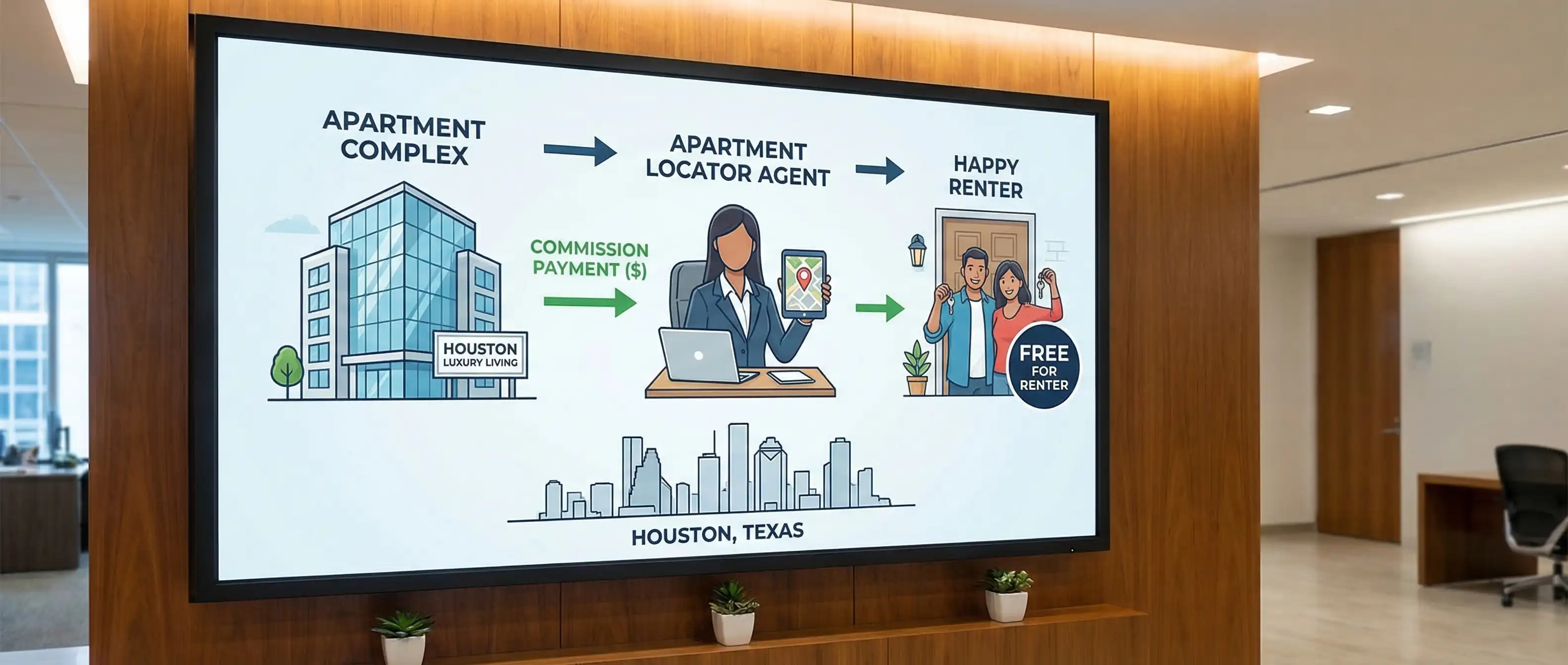
Apartment locators in Houston advertise their services as "free." And they are — to you. But free does not mean no one is paying. Understanding the commission model helps you evaluate whether a locator's recommendations are genuinely in your best interest or influenced by which properties pay the highest referral fees. This guide explains exactly how the money flows, what to watch for, and how to protect yourself.
How the Commission Model Works
You contact a locator with your apartment requirements
Budget, preferred neighborhoods, move-in date, apartment size, must-have amenities.
The locator searches their inventory and creates a shortlist
They pull from properties that have agreements to pay referral commissions. Not all apartments participate.
You tour apartments and choose one
The locator may accompany you on tours or arrange self-guided and virtual tours.
You sign a lease
Your rent is the same whether you used a locator or found the apartment on your own.
The apartment community pays the locator a commission
Typically 50-100% of the first month's rent, paid directly by the property's management company. You pay nothing.
Commission Rates by Lease Type
Commission rates vary by property type, lease length, and occupancy level. Properties with more vacancies to fill tend to offer higher commissions.
| Lease Type | Typical Commission | Notes |
|---|---|---|
| Standard 12-month lease | 50-100% of first month's rent | Most common arrangement in Houston |
| Short-term (3-6 months) | 25-50% of first month's rent | Lower payout due to shorter commitment |
| Luxury / High-Rise | 75-150% of first month's rent | Premium properties pay more to attract tenants |
| Corporate relocation | Flat fee ($500-$2,000) | Negotiated directly with the employer or relocation company |
The Steering Problem
The fundamental conflict in the apartment locator model is simple: locators earn more money from some properties than others. This creates a financial incentive to recommend higher-commission apartments — even when a lower-commission property might be a better fit for your needs and budget.
For example, a luxury high-rise paying 100% of first month's rent ($2,500 commission) is far more lucrative for a locator than a suburban garden-style apartment paying 50% ($550 commission). A good locator will still recommend the best fit. A commission-driven locator will push the luxury property.
Signs of commission-driven steering:
- ⚠ All recommended apartments are from the same management company
- ⚠ Recommendations consistently exceed your stated budget
- ⚠ The locator dismisses or downplays properties you found independently
- ⚠ They pressure you to decide quickly without letting you compare options
- ⚠ They refuse to answer questions about their commission structure
Ghost Listings & Bait-and-Switch Tactics
A growing problem in Houston's apartment locator industry is "ghost listings" — fake or outdated apartment listings posted on Craigslist, Facebook Marketplace, TikTok, and Instagram to attract inquiries. The pattern works like this:
- A locator posts an unrealistically cheap listing for a desirable neighborhood (e.g., "1BR in Montrose, $900/mo")
- When you inquire, they say that unit is "just leased" or "no longer available"
- They immediately pivot to showing you other (higher-commission) properties they actually want to place you in
- You've now given them your contact information and they have a guest card submitted in their name
Red Flags to Watch For:
- ⚠ No specific unit number, floor plan, or move-in date in the listing
- ⚠ Price is 20-30% below comparable units in the same neighborhood
- ⚠ Photos are generic stock images or clearly from a different property
- ⚠ The listing disappears immediately after you make contact
Protect yourself: Always verify listings independently on Apartments.com, the property's own website, or by calling the leasing office directly. If a locator's listing seems too good to be true, it almost certainly is.
Questions to Ask Your Locator
A trustworthy locator will answer these questions confidently and transparently. Hesitation or defensiveness is a red flag.
- ● Do you receive different commission rates from different properties?
- ● Are you showing me apartments from multiple management companies or just one?
- ● Will you disclose the commission percentage you earn from each property you recommend?
- ● Are there apartments that fit my criteria but that you cannot place me in (because they don't pay commissions)?
- ● How do you decide which apartments to include on my shortlist?
- ● Are you a licensed TREC real estate agent? What is your license number?
- ● Have you personally toured the properties you are recommending?
The Guest Card: How Commission Attribution Works
A guest card is the document that ties your apartment visit to a specific locator. When you tour an apartment — whether in person, self-guided, or virtually — the leasing office logs which locator referred you. Whichever locator's name is on that guest card gets the commission if you sign a lease there. This is the single most important mechanism in the commission model.
Key Rules to Know:
- ● First card wins: The first locator whose guest card is submitted for a property gets the commission — period. If Locator A submits a guest card and you later try to use Locator B for the same property, Locator A gets paid.
- ● Never let a locator submit cards without your knowledge: Some locators bulk-submit guest cards to "lock in" commission at multiple properties before you've even toured them. Ask which properties they've submitted cards for.
- ● Protect your walk-in ability: If you find an apartment on your own (via Apartments.com, Zillow, or driving by), visit the leasing office directly. Do not let a locator submit a guest card for properties you discovered independently — they did not earn that commission.
- ● Guest cards have expiration dates: Most properties honor guest cards for 30-90 days. After that, you may be able to visit through a different locator or directly without commission attribution.
Your Rights as a Renter in Texas
- ✓ All apartment locators in Texas must hold a valid TREC real estate license — verify at trec.texas.gov
- ✓ You have the right to ask your locator about their commission structure and they should answer transparently
- ✓ You are never required to pay a locator fee — if someone asks you for money, walk away
- ✓ You can file a complaint with TREC if a locator engages in deceptive practices (trec.texas.gov/complaints)
- ✓ You can work with multiple locators simultaneously — there is no exclusivity requirement unless you sign one
- ✓ Your rent should be the same whether you use a locator or find the apartment yourself
- ✓ A locator cannot legally prevent you from leasing at a property they showed you, even if you go directly
TREC Legal Framework: Texas Statutes & Rules
Understanding the specific laws that govern apartment locators in Texas helps you hold your locator accountable and recognize violations.
- ● TRELA §1101.002(6): Defines "broker" to include anyone who procures or assists in procuring a tenant for real property — apartment locators are explicitly covered under this definition and must be licensed.
- ● TRELA §1101.351(a)(2): Makes it a criminal offense (Class A misdemeanor) to act as a real estate broker or salesperson without an active TREC license. Anyone locating apartments for compensation without a license is operating illegally.
- ● TREC Rule 535.4(k): All advertising by a license holder must include the name of the license holder's sponsoring broker or the broker's trade name. Instagram-only locators with no brokerage disclosure are in violation.
- ● TREC §531.2 & §531.3: Canons of Professional Ethics requiring fidelity (loyalty to the client's interest) and integrity (honest dealing). A locator who steers you to high-commission properties without disclosure violates these canons.
- ● TREC Rule 535.155: Requires disclosure of commission sharing arrangements. If your locator receives a bonus, incentive, or higher-than-standard commission from a specific property, they must disclose this when asked.
About the IABS Form
The Information About Brokerage Services (IABS) form is a TREC-required document that every licensed locator must provide to you at first substantive contact — before discussing your apartment needs in detail. It explains the types of agency relationships (customer vs. client), your rights, and how the locator is compensated. If a locator does not offer this form voluntarily, ask for it. Refusal to provide it is a TREC violation you can report at trec.texas.gov.
The "Preferred Property List" Problem
Most Houston apartment locators work from a "preferred property list" — a curated set of apartment communities that have existing commission agreements with the locator's brokerage. This is not inherently bad, but it means your locator's recommendations are limited to properties that pay them.
What This Means for You:
- ⚠ Mom-and-pop landlords are excluded: Independently owned duplexes, fourplexes, and small apartment buildings — often the best value in Houston's Inner Loop neighborhoods like Montrose, the Heights, and EaDo — typically do not participate in locator commission programs. Your locator has zero financial incentive to show you these properties.
- ⚠ Large management companies dominate: Preferred lists heavily favor national operators like Greystar, Camden, MAA, and Cortland — properties with marketing budgets large enough to pay locator commissions. These are often fine apartments, but they're not the only options.
- ⚠ Supplement with your own research: Search HAR.com rentals, Zillow, and Craigslist (carefully) for independently owned properties that locators won't show you. Drive target neighborhoods and look for "For Rent" signs on smaller buildings.
Apartment Underwriting Criteria in Houston
Most Houston apartment communities use automated screening through platforms like RealPage Leasing Desk or Experian RentBureau. Understanding these criteria helps you prepare before applying:
| Criteria | Standard Requirement | Impact if Below |
|---|---|---|
| Income | 3x gross monthly rent | Denial or co-signer required |
| Credit Score 750+ | Best rates, lowest deposits | N/A — premium tier |
| Credit Score 700-749 | Standard approval | Standard deposit required |
| Credit Score 650-699 | Conditional approval | Higher deposit ($200-$500 extra) |
| Credit Score Below 650 | Likely denial at Class A/B | Second-chance locator recommended |
| Rental History | 2+ years positive history preferred | Eviction in past 5 years typically disqualifying |
| Criminal Background | Felony-free for 7-10 years | Felony in past 7-10 years typically disqualifying; misdemeanors case-by-case |
Tip: If your profile doesn't meet standard criteria, ask your locator about properties with manual underwriting that review applications individually rather than relying solely on automated screening algorithms.
Rebate Programs: Delays & Void Conditions
Some Houston locators offer cash-back rebates ($50-$200) as an incentive. While legitimate, these programs come with fine print that many renters miss:
- ⚠ 60-90 day payout delay: Rebates are typically not paid until 60-90 days after lease signing — the locator must first receive their commission from the apartment community, which itself takes 30-60 days.
- ⚠ Void conditions: Most rebate programs are voided if you break your lease early, transfer units, or if the apartment community reduces or withholds the locator's commission for any reason. Read the rebate terms in writing before counting on the money.
- ⚠ Get it in writing: Any rebate promise should be documented in writing with specific dollar amount, payout timeline, and void conditions. Verbal rebate promises are unenforceable.
For detailed rebate comparisons, see our Houston Apartment Cost Guide.
Commission-Related Red Flags
Watch for these commission-specific warning signs when working with any Houston apartment locator:
- ⚠ All recommended apartments are from the same management company (likely a preferred commission arrangement)
- ⚠ Locator refuses to show you properties you found independently on Apartments.com or Zillow
- ⚠ Recommendations consistently exceed your stated budget (pushing toward high-commission luxury properties)
- ⚠ Locator submits guest cards to multiple properties without your explicit consent
- ⚠ Promises a rebate verbally but refuses to put the terms in writing
See the full 17-point red flags list on our Houston Apartment Locators directory page.
Apartment Locator Commission FAQs
Frequently Asked Questions
Are apartment locators really free in Houston?
Yes — apartment locators are free to renters. The apartment community pays the locator a referral commission (typically 50-100% of one month's rent) when you sign a lease. This commission is a budgeted marketing expense for the property — similar to what they spend on advertising, listing sites, and leasing staff. Your rent is the same whether you use a locator or not.
How much commission do Houston apartment locators earn?
Houston locators typically earn 50-100% of the first month's rent on standard 12-month leases. Luxury and high-rise properties may pay 75-150%. Short-term leases (3-6 months) usually pay 25-50%. The exact rate depends on the property, time of year, and occupancy level. Properties with higher vacancy rates often pay higher commissions to attract tenants faster.
Can a locator steer me toward higher-commission apartments?
Yes, this is the primary conflict of interest in the locator model. Since locators earn different commission rates from different properties, there is a financial incentive to recommend apartments that pay more — even if they are not the best fit for you. Protect yourself by asking upfront whether they earn the same rate from every property and by independently researching options on sites like Apartments.com and Zillow.
Should I sign an exclusivity agreement with a locator?
Generally, no. Most reputable Houston locators do not require exclusivity agreements. If a locator asks you to sign one, it means you cannot work with another locator or lease directly without owing them a fee. There is rarely a benefit to the renter in signing an exclusive agreement. Politely decline and work with locators who earn your business through service quality, not contractual obligation.
What happens if I find an apartment on my own after talking to a locator?
If you have not signed an exclusivity agreement, you are free to lease any apartment through any channel. However, if a locator introduced you to a specific property (e.g., scheduled a tour), some communities will credit the commission to that locator regardless. If you want to go direct, be upfront with both the locator and the property to avoid disputes. Ethically, if a locator did meaningful work for you, consider letting them complete the placement.
Related Houston Apartment Guides
Rent Cost Guide
Houston rent prices by neighborhood, apartment size, and season with hidden cost breakdowns.
Neighborhood Guide
Compare Houston neighborhoods by rent, walkability, commute time, and lifestyle fit.
Apartment Hunting Checklist
Step-by-step timeline from research to move-in with TREC verification steps.
Sources & References (4)
- [1]Texas Real Estate Commission (TREC)— License verification and regulatory oversight
- [2]Better Business Bureau— Business ratings and complaint history
- [3]Zillow Rent Data— Rental market trends and median rent estimates
- [4]U.S. Census Bureau— Neighborhood demographics and housing statistics
Reviewed by RelocateMeTX Editorial Team
Content verified March 2026. Relocation information on this page has been reviewed for accuracy against primary sources — see how we verify our data. This guide is for informational purposes only and does not constitute professional financial, legal, or medical advice.