
When you compare houston vs dallas cost of living in 2026, the headline is clear: Houston is roughly 8% cheaper. That’s the number from Numbeo’s cost-of-living index (Q1 2025, the most recent available), where Houston scores 60.6 versus Dallas’s 65.8. Housing accounts for most of it. Houston’s median sale price sits at $349,769 compared to $448,703 in Dallas (city median sale price, Redfin, Aug 2026), and a typical two-bedroom apartment runs $1,506/mo in Houston versus $1,816 in Dallas. But that 8% gap hides expensive surprises on both sides: flood insurance that only Houston buyers pay, property tax rates that vary wildly by jurisdiction, and summer electricity bills that hit Houston harder than Dallas. This breakdown uses RentCafe, Redfin, the Texas Comptroller, SmartAsset, and MoneyGeek’s 2026 data so you can run the comparison against your own budget.
Houston vs Dallas Cost of Living 2026: The Bottom Line
The table below puts the key numbers side by side. Every figure is sourced and current as of early 2026.
| Category | Houston | Dallas | Cheaper City |
|---|---|---|---|
| Median Sale Price (city, Redfin, Aug 2026) | $349,769 | $448,703 | Houston |
| Avg 2BR Rent | $1,506/mo | $1,816/mo | Houston |
| Property Tax (combined, pre-exemption) | ~2.0% | ~2.23% | Houston |
| Homestead Exemption | $140,000 | $140,000 | Tie |
| Avg Electricity Rate | 15.07¢/kWh | 15.43¢/kWh | Nearly equal |
| Groceries | 5–8% below national avg | 5–8% below national avg | Tie |
| Auto Insurance | ~$198/mo | ~$195/mo | Nearly equal |
| State Income Tax | 0% | 0% | Tie |
Sources: Numbeo Q1 2025, RentCafe Feb 2026, SmartAsset, MoneyGeek 2026.
Sponsored: RelocateMeTX is affiliated with Houston Corporate Housing.
Housing: Where the $99K Gap Lives
The gap starts with the sticker price. Across the metro, Houston’s single-family median is $330,000 (HAR, August 2026, Greater Houston single-family). On a same-basis city comparison, Houston’s median sale price is $349,769 and Dallas’s is $448,703 (city median sale price, Redfin, Aug 2026). That $98,934 difference is the single biggest line item separating these two metros, and it compounds over a 30-year mortgage into hundreds of thousands in total interest paid. For a closer look at what Dallas neighborhoods actually cost block by block, see our Dallas cost of living by neighborhood breakdown.
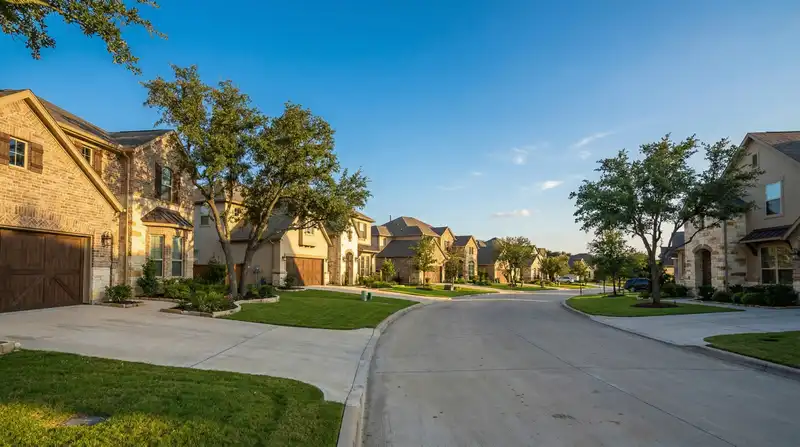
Renters see a similar spread. A two-bedroom apartment averages $1,506/mo in Houston versus $1,816 in Dallas per RentCafe (February 2026). For one-bedrooms, Dallas runs $1,355/mo (Zumper, April 2026); Houston’s citywide average is $1,181 (RentCafe, early 2026). That’s $310/mo in rent savings on a 2BR, or $3,720 per year, before you’ve compared a single grocery receipt.
Why does Houston stay cheaper? No zoning. Houston has no traditional zoning ordinances, which means developers can build housing almost anywhere demand shows up. Dallas has conventional zoning that restricts supply in desirable areas. The result: Houston added housing stock faster through the 2020s, and prices reflect that supply difference. The practical upshot: you usually get more square footage per dollar in Houston, but check the flood zone before you sign anything.
At the neighborhood level, the picture gets sharper:
| Neighborhood Type | Houston Example | Houston Price | Dallas Example | Dallas Price |
|---|---|---|---|---|
| Walkable urban core | Montrose | $1,400–$1,700/mo (2BR) | Uptown | $1,850–$2,100/mo (2BR) |
| Family suburb (new build) | Katy | $350K–$400K | Frisco | $500K–$615K |
| Affordable starter area | Spring | $250K–$300K | Mesquite | $280K–$340K |
Explore Houston neighborhoods and Dallas neighborhoods for street-level detail. For Dallas housing data specifically, see our Dallas housing guide.
RelocateMeTX is affiliated with F.A.D Furnished Apartments and Houston Corporate Housing.
Property Taxes: The Hidden Cost That Changes Everything
Texas charges zero state income tax. That saves a $90,000 household roughly $4,500 per year compared to a state with a 5% rate. But property taxes claw most of it back.

A City of Houston address in Houston ISD carries a combined rate of about 2.1% before exemptions (the sum of all taxing units’ 2025 adopted rates; Harris County Tax Office). The city of Dallas combined rate (city, county, school district, hospital, and college) is about 2.23% before exemptions; suburbs with MUD/PID run higher. After the homestead exemption, a new owner’s effective rate in the city of Dallas is about 1.58–1.74%.
On an apples-to-apples $350,000 home, the math works out like this:
| Tax Line Item | Houston | Dallas |
|---|---|---|
| State income tax saved (vs 5% state) | +$4,500 | +$4,500 |
| Property tax on $350K home | −$7,000 | −$7,800 |
| Homestead exemption savings (est.) | +$1,700 | +$1,700 |
| Sales tax (8.25% both) | Same | Same |
| Net position vs income-tax state | −$800/yr | −$1,600/yr |
Both cities use the $140,000 Texas Homestead Exemption (SB 4, approved November 2025), which reduces your assessed value for school district taxes. In Dallas ISD that saves about $1,391 a year at the 2025 rate of 0.993835 per $100 (Dallas County Tax Office); elsewhere the saving depends on the local school tax rate. For the full mechanics of how rates vary by county and school district, read our Texas property tax breakdown.
The takeaway for homebuyers: the “no income tax” advantage is nearly erased by property tax in Houston and fully erased in Dallas. Our no-income-tax break-even study runs that math bracket by bracket, including the home price at which the tax savings disappear entirely. Renters are the real winners. They capture the income tax savings without the property tax bill hitting them directly. A renter in Texas earning $90K keeps roughly $4,500 more per year than they would in a mid-tax state. Real money.
Groceries, Utilities, and Daily Expenses
Groceries are a wash. Both metros run 5–8% below the national average. Your weekly H-E-B or Tom Thumb run won’t look meaningfully different.
Electricity is where it gets interesting. Both cities sit in Texas’s deregulated market, meaning you pick your retail provider through PowerToChoose.org. Base rates look almost identical: 15.07¢/kWh in Houston (CenterPoint territory) versus 15.43¢/kWh in Dallas (Oncor territory) per Texas Electricity Ratings. Savvy shoppers in Dallas can lock 12-month plans under 9¢/kWh; Houston’s cheapest start around 9.5¢/kWh.
Summer flips the script. Houston’s humidity forces AC units to work harder and run longer. Expect 15–20% higher electricity bills from June through September in Houston compared to a similar-sized Dallas home. Over a full year, that’s $200–$400 extra. See our Texas electricity guide for a walkthrough on shopping rates in either city.
Jobs and Salaries: What You’ll Actually Earn
Houston’s economy runs on energy, healthcare, and aerospace. The Texas Medical Center alone is home to about 106,000 employees (TMC), and 27 Fortune 500 companies (2026 list) headquarter in the Houston metro. Dallas leans finance, tech, and corporate operations, with 24 DFW companies on the 2026 Fortune 500 list, per CultureMap Dallas. Toyota, Charles Schwab, Goldman Sachs, and CBRE all have major Dallas-area operations that didn’t exist a decade ago.
Dallas’s median household income is $74,323 (Census 2024 ACS). For a deeper look at what you’d need to earn, check our salary needed to live in Dallas calculator. The job market math is straightforward: if you’re in energy or healthcare, Houston gives you more employers competing for your skills. If you’re in tech, finance, or corporate roles, Dallas has the deeper bench. Neither city has a shortage of work.
Transportation: Gas, Tolls, and Commute Costs
Both cities are car-dependent. Neither METRO (Houston) nor DART (Dallas) replaces a car for most commuters. The real cost difference hides in four line items that add up fast.

Tolls. Dallas leans heavily on toll roads run by the NTTA. A 20-mile round-trip toll commute costs $88–$100/mo with a TollTag. Longer routes like Frisco to downtown on the Dallas North Tollway push past $150/mo. Houston’s HCTRA system prices per-plaza ($0.48–$2.00 per toll point), and a typical Sam Houston Tollway commute runs $80–$150/mo. See our Texas toll roads guide for rates and tag options. You can also estimate your specific commute cost using our Dallas commute calculator.
Gas and insurance. Prices hover around $2.85–$3.10/gallon in both metros, with Houston running slightly cheaper thanks to Gulf Coast refinery proximity. Full-coverage auto insurance averages $198/mo in Houston and $195/mo in Dallas (MoneyGeek 2026). About 20% of Texas drivers carry no insurance per the Insurance Information Institute, which pushes premiums up for everyone else.
Commute time. Houston drivers lose 77 hours per year to congestion; Dallas drivers lose 69, according to the INRIX 2025 Traffic Scorecard. Eight hours per year is a full workday sitting on I-45 or I-35E. Dallas does have one transit advantage: DART’s 93-mile light rail network connects Plano, Richardson, and downtown. Houston’s METRO runs 23 miles of rail plus 85+ bus routes. If your office sits along a Dallas rail line, going car-light is genuinely possible.
Which City Is Cheaper for YOUR Situation?
The 8% headline doesn’t apply equally to everyone. Your career, housing type, and family size shift the math in different directions.
Single renter, under 35. Houston wins outright. You’ll pay $310/mo less on a 2BR (split with a roommate, that’s $155 each) and capture the full no-income-tax benefit without any property tax offset. Montrose and the Heights give you walkability that competes with Uptown Dallas at 20–30% lower rent.
Couple buying their first home. Houston wins on price ($350K vs $449K city median sale price, Redfin, Aug 2026), but look at the full picture. Your career field matters more than the sticker price. If both of you work in finance or tech, Dallas likely offers higher combined household income that closes the housing gap. If one of you is in healthcare or energy, Houston’s employer density is hard to beat.
Family with school-age kids. Close call. Katy ISD (Houston) scored a high B (88/100) on TEA accountability ratings, and the housing cost to access it runs $150,000–$200,000 less than A-rated Frisco ISD (Dallas): Katy homes sell for $350K–$400K versus a Frisco median around $550K. Houston’s childcare runs $900–$1,100/mo per child versus $1,000–$1,200 in Dallas. But Frisco’s higher district rating and newer suburban infrastructure (wider roads, newer school buildings, less flooding risk) appeal to families who prioritize those factors. Neither city is wrong here.

Remote worker. Dallas edges ahead for most. DFW’s coworking density, airport connectivity for occasional travel, and predictable toll-road commutes tip the balance. Houston offers a lower cost floor, but the humidity wears on you when your commute is fifteen feet from bed to desk, every day, May through October.
The Verdict: Houston vs Dallas in 2026
If you’re renting on a budget, pick Houston. Not close. You’ll save $3,700/yr on rent alone, food costs are equivalent, and the no-income-tax benefit flows straight to your bank account without a property tax offset eating into it.
But if you’re buying a home and work in tech, finance, or corporate operations, Dallas justifies the premium. The math: higher salaries in those sectors, better long-term appreciation in the suburbs, zero flood insurance line items, and a property tax situation that’s at least predictable even if it’s high. You’re paying more, but you know exactly what you’re paying. Houston buyers in some neighborhoods can’t say the same until they’ve checked the flood zone maps, gotten insurance quotes, verified whether their street sits in a MUD, and budgeted for summer electricity bills that make their eyes water. Predictability has a price, and Dallas charges it upfront.
"The 8% gap is real, but it's a starting point, not a verdict. Your career field, flood zone tolerance, and whether you're renting or buying will shift the math more than any cost index."
Start planning with our Houston moving guide or Dallas moving guide. For a broader look at each city, explore the full Houston hub or Dallas hub. For the deeper Dallas verdict, our is Dallas a good place to live deep dive and pros and cons of moving to Dallas analysis cover the angles this comparison doesn’t. And for out-of-staters considering Texas in general, our California to Texas moving guide covers the adjustment.
FAQ: Houston vs Dallas Cost of Living
Is it cheaper to live in Houston or Dallas?
Houston, by about 8% overall. Housing drives the gap: a $349,769 median sale price versus $448,703 in Dallas (city median sale price, Redfin, Aug 2026), and 2BR rents are $310/mo lower. Groceries, gas, and sales tax are nearly identical between the two cities, so the savings concentrate almost entirely in your housing payment.
Are property taxes higher in Houston or Dallas?
Dallas and Houston have comparable property-tax burdens. The city of Dallas combined rate is about 2.23% of value before exemptions; a City of Houston address runs about 2.1% (all taxing units, Harris County Tax Office). On a $350,000 home that’s roughly $7,800/yr in Dallas versus about $7,350 in Houston before exemptions. Both cities apply the $140,000 Texas Homestead Exemption (SB 4, 2025); after it, a new owner’s effective rate is about 1.58–1.74% in the city of Dallas, saving a Dallas ISD homeowner about $1,391 a year on school district taxes (2025 rate 0.993835 per $100, Dallas County Tax Office).
What salary do you need to live comfortably in Houston vs Dallas?
A single person needs about $97,000/yr to live comfortably in Dallas, using SmartAsset’s method: MIT’s Dallas County living wage, doubled (our calculation; see our full Dallas salary breakdown, which puts a family of four at $150,000–$180,000). Run the same method on MIT’s Harris County figures for Houston.
Is Dallas or Houston better for families?
Both metros have top-rated suburban school districts. The differentiator is cost of entry: homes in Katy ISD (Houston, TEA B rating, 88/100) run $350,000–$400,000 versus roughly $550,000 in A-rated Frisco ISD (Dallas), a gap of $150,000–$200,000. Houston childcare averages $900–$1,100/mo per child versus $1,000–$1,200 in Dallas. Dallas suburbs have newer infrastructure and minimal flood risk.
Which is better for jobs, Houston or Dallas?
It depends on your field. Houston dominates energy, healthcare, and aerospace (27 Fortune 500 HQs on the 2026 list, Texas Medical Center). Dallas leads in tech, finance, and corporate relocations (a deep Fortune 500 roster, plus Toyota, Schwab, Goldman). For general white-collar work, both metros hire steadily; unemployment was 5.2% in Houston and 4.7% in Dallas-Fort Worth in June 2026 (BLS, not seasonally adjusted).
Should I move to Houston or Dallas in 2026?
If you’re renting and budget-conscious, Houston. You’ll save $3,700/yr on rent and get more house per dollar. If you’re buying and work in tech or finance, Dallas. The higher salary potential and home appreciation trends offset the premium. If you’re a family choosing between school districts, both cities offer comparable quality at very different price points. The cost gap alone doesn’t justify the move; your career and lifestyle preferences should drive the decision.
Houston Corporate Housing offers furnished apartments with month-to-month leases across Greater Houston.
Sponsored: RelocateMeTX is affiliated with Houston Corporate Housing.
Related Resources
For Dallas-bound readers:
- Dallas Hub: full DFW relocation overview
- What Salary You Need to Live in Dallas
- Dallas Property Taxes Explained
- 20 Pros and Cons of Moving to Dallas
For Houston-bound readers:
- Houston Hub: full Houston relocation overview
- Why Houston Is a Top City for Families
Written April 2026; figures updated August 2026. Housing data: HAR August 2026 (Greater Houston single-family), Redfin city median sale prices, August 2026 (Houston and Dallas). Rent data: RentCafe and Zumper, February–April 2026. Cost-of-living index: Numbeo Q1 2025. Property tax rates: SmartAsset. Insurance data: MoneyGeek 2026. This article contains sponsored links to Houston Corporate Housing and Furnished Apartments Dallas. For ad inquiries, contact [email protected].