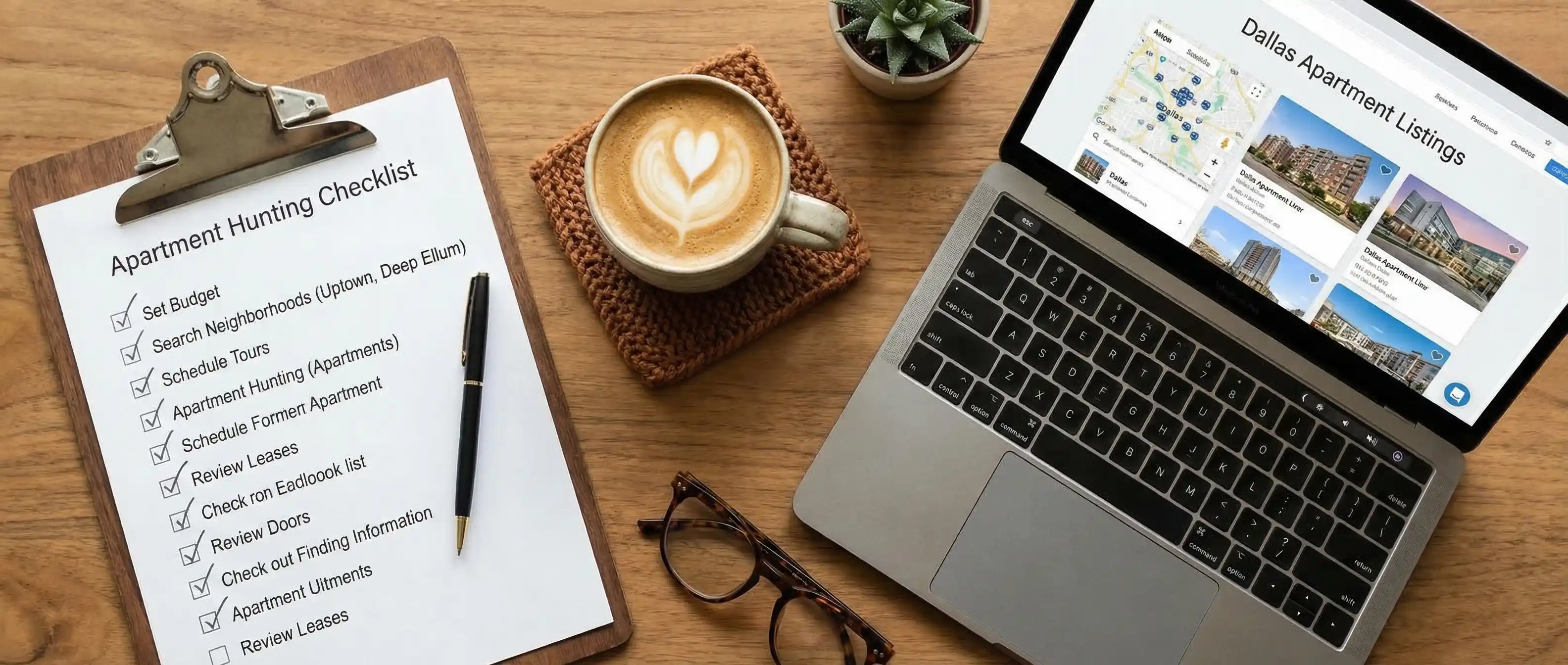
Dallas Apartment Hunting Checklist (2026)
Finding the right apartment in DFW takes more than scrolling Zillow. This step-by-step checklist covers every phase from initial research to move-in day, with Dallas-specific guidance on toll roads, DART, hail season, and the hidden fees that add $200-$500/month to your base rent. Print it, share it, and check off each item as you go. Updated March 2026.
6-8 Weeks Before Move-In
- Define your budget — include rent, utilities ($100-$200), valet trash ($25-$40), parking ($0-$200), pet rent ($20-$50), and renters insurance ($15-$30)
- Research DFW neighborhoods — decide between Dallas proper (Uptown, Deep Ellum, Knox-Henderson) or suburbs (Frisco, Plano, Fort Worth) based on commute and lifestyle
- Check your credit score — most DFW communities require 600+ for approval; luxury Uptown properties may require 700+
- Contact 2-3 apartment locators — verify TREC license at trec.texas.gov before sharing personal information
- Ask locators about commission disclosure — "Do you earn the same commission from every property you recommend?"
- Start saving for move-in costs — first month's rent + deposit ($200-$500) + admin fee ($150-$400) + application fees ($50-$100 per property)
- If relocating from out of state, request virtual tours and neighborhood walkthrough videos from your locator
- Research DART rail routes if transit commuting — the ~17.9% rent premium near stations may be offset by eliminating car costs
4-6 Weeks Before Move-In
- Narrow your list to 5-8 properties based on locator recommendations and your own Apartments.com/Zillow research
- Schedule in-person or virtual tours — visit top choices on different days and times (weekday evening and weekend morning)
- During tours, check water pressure, outlet count, cell signal strength, closet space, and natural light
- Ask about lease terms — start date flexibility, early termination fee (typically 2 months rent), and renewal rate history
- Compare total monthly cost, not just base rent — add all mandatory fees to create an apples-to-apples comparison
- Ask current residents about maintenance response times, package theft, noise levels, and management quality
- Verify parking situation — covered vs. uncovered, garage availability, guest parking policies
- If you have pets, confirm breed/weight restrictions, pet deposit amount, and monthly pet rent in writing
2-4 Weeks Before Move-In
- Apply to your top choice — have pay stubs (3 months), ID, Social Security number, and employer verification letter ready
- Read the full lease before signing — pay attention to early termination clause, renewal terms, and fee schedule
- Negotiate concessions — especially during slow months (Nov-Feb): free month, waived admin fee, reduced deposit, or free parking
- Set up renter's insurance — required by most DFW communities; compare quotes before accepting the property's preferred provider
- Set up electricity through your chosen REP (Retail Electric Provider) — Texas has deregulated electricity; compare rates at powertochoose.org
- Set up internet — AT&T Fiber and Spectrum are the primary DFW providers; check availability at your specific address
- If using a locator's free move benefit, confirm the details: hours included, insurance coverage, and scheduling window
- Order an NTTA TollTag if your commute involves DNT, PGBT, or Sam Rayburn Tollway — avoid $1.50+ per-use surcharges
1-2 Weeks Before Move-In
- Confirm your move-in date and time with the apartment community — some only do move-ins on weekdays
- Reserve the freight elevator if moving into a high-rise (Uptown, Downtown, Deep Ellum) — may require 48-72 hours notice
- Submit your moving company details to the apartment office — many communities require certificate of insurance from movers
- Do a final walkthrough before signing the move-in condition form — photograph every scratch, stain, and imperfection
- Prepare certified funds for any remaining move-in payments — some communities do not accept personal checks at move-in
- Forward your mail via USPS — update your address with banks, insurance, DMV, and employer
- Pack a "first night" box: toilet paper, towels, phone chargers, medications, snacks, and basic cleaning supplies
Move-In Week
- Pick up keys and complete the move-in inspection form — document everything with timestamped photos and email them to management
- Test all appliances, HVAC, faucets, toilets, and garbage disposal on day one — report issues in writing immediately
- Introduce yourself to the leasing office and ask about community events, package locker codes, and maintenance request procedures
- Set up your DART GoPass app if using public transit — monthly local pass is $126, regional is $192
- Register your vehicle with apartment management if required — obtain parking permit or garage remote
- Update your driver's license to your new Texas address within 90 days if relocating from out of state (visit txdmv.gov)
- Locate the nearest grocery stores, pharmacy, urgent care, and your designated USPS post office
- Test your commute during actual rush hour — DFW traffic patterns vary dramatically by day and route
Dallas-Specific Considerations
DFW has unique factors that do not apply in other Texas metros. Address each of these before signing your lease.
Toll Roads (NTTA)
DFW has the most extensive toll road system in Texas. The Dallas North Tollway (DNT), Sam Rayburn Tollway (SRT), President George Bush Turnpike (PGBT), and others can cost commuters $100-$250/month. Get an NTTA TollTag — ZipCash (pay-by-mail) costs 50% more. Factor toll costs into your budget when choosing between neighborhoods.
DART Pass
If you live and work near DART rail stations, a monthly pass ($126 local / $192 regional) can replace a car. The GoPass app works for buses, rail, and TRE (Trinity Railway Express to Fort Worth). Evaluate whether the ~17.9% DART rent premium is offset by eliminating $500-$800/month in car costs.
Hail Season (March-May)
DFW is in the heart of North Texas hail alley. Severe hailstorms cause billions in damage annually. When apartment hunting, prioritize covered or garage parking to protect your vehicle. Ensure your renters insurance includes personal property coverage for hail damage. Check if the apartment has experienced roof or window damage claims recently.
Property Tax Impact on Rent
Texas has no state income tax, but Dallas County effective property tax rates are 1.8-2.4% — among the highest in the nation. Apartment owners pass this cost directly into rent. Expect 1-3% annual rent increases tied to Dallas Central Appraisal District revaluations. This is why DFW rents have risen steadily despite massive new construction.
Deregulated Electricity
Texas has a deregulated electricity market. You choose your Retail Electric Provider (REP) — do not just accept the apartment's default suggestion. Compare rates at powertochoose.org. Fixed-rate plans (12-24 months) protect against summer price spikes. Average DFW electricity bills run $100-$200/month depending on apartment size and season.
Winter Ice Storms (Uri Legacy)
Winter Storm Uri (February 2021) exposed critical infrastructure vulnerabilities across DFW. When apartment hunting, ask management directly: "How did this building perform during Uri?" Check whether the property has backup generators, insulated pipes, and a documented winter weather emergency plan. Buildings that experienced burst pipes and multi-day power outages without remediation should be avoided. Properties built or renovated after 2021 are more likely to have weatherization upgrades.
HOA Restrictions in Master-Planned Communities
Apartment communities within Frisco, Plano, and McKinney master-planned developments may be subject to HOA rules that restrict balcony decor, pet breeds/sizes, vehicle parking (no commercial vehicles or RVs), grill types, and even move-in/move-out hours and days. These restrictions go beyond the apartment lease terms. Ask your locator and the leasing office for the full HOA covenant before signing — violations can result in fines passed through to your rent.
What to Bring When Applying
- ● Government-issued photo ID (driver's license or passport)
- ● Social Security number (or ITIN)
- ● Proof of income: 3 most recent pay stubs or offer letter (most communities require 3x rent in gross income)
- ● Bank statements (last 2 months) — some communities accept these in lieu of pay stubs for self-employed applicants
- ● Employer verification letter with start date, salary, and contact information
- ● Previous landlord contact information for rental history verification
- ● Pet vaccination records and photos (if applicable)
- ● Vehicle information: make, model, year, license plate, and insurance
- ● Certified check or money order for deposit and first month's rent (confirm accepted payment methods in advance)
- ● Renter's insurance declaration page (many communities require active policy before key handoff)
Questions to Ask During Tours
- What is the total monthly cost including all mandatory fees? (base rent + valet trash + pest control + amenity fee + parking)
- What is the early termination penalty and required notice period?
- What was the rent increase at the last renewal cycle?
- How quickly does maintenance respond to emergency vs. non-emergency requests?
- Is the building on DART rail, and what is the actual walk time to the platform?
- Has the property experienced any flooding, hail damage, or pipe burst events in the last 3 years?
- What is the package theft rate, and is there a secure package locker system?
- Are there any upcoming construction projects, renovations, or highway expansions near the property?
- What internet providers service this building, and what speeds are available?
- Is covered or garage parking available, and what is the monthly cost?
Dallas Apartment Hunting FAQs
Frequently Asked Questions
How far in advance should I start apartment hunting in Dallas?
Start 6-8 weeks before your target move-in date during peak season (May-August) and 4-6 weeks during off-peak months. If relocating from out of state, contact a locator as soon as you accept a job offer — they can begin virtual research immediately. Most Dallas apartments become available for viewing 30-60 days before the available date, so starting earlier than 8 weeks means you will mostly be researching neighborhoods, not touring specific units.
What credit score do I need to rent in Dallas?
Most DFW apartment communities require a minimum credit score of 580-620 for standard approval. Luxury Uptown and Turtle Creek properties often require 680-720+. If your score is below the minimum, many communities offer conditional approval with a higher deposit (1.5-2x monthly rent) or a co-signer. Some budget-friendly communities in Fort Worth and Arlington offer "second chance" leasing for applicants with past evictions or credit issues.
How much should I budget for move-in costs in DFW?
Budget 2.5-3.5x your monthly rent for total move-in costs. On a $1,500/month apartment, expect: first month rent ($1,500) + security deposit ($200-$500) + admin fee ($150-$400) + application fee ($50-$100) + renter's insurance setup ($30-$50) + electricity deposit ($0-$200 depending on credit) + pet deposit if applicable ($200-$500). Total: approximately $2,130-$3,250. During off-peak months, locators can often negotiate waived admin fees or reduced deposits.
Should I get an NTTA TollTag before moving to Dallas?
Yes, if your commute involves any toll roads — and in DFW, most commutes do. The Dallas North Tollway, Sam Rayburn Tollway, President George Bush Turnpike, and several managed toll lanes are heavily used. NTTA TollTag users pay standard rates; ZipCash (pay-by-mail without a tag) costs 50% more per transaction. You can order a TollTag online at ntta.org before you arrive and have it shipped to your new address. Budget $100-$250/month in tolls depending on your commute.
Do I need a car in Dallas?
In most of DFW, yes — the metro is car-dependent. The exception is Uptown Dallas, where you can live car-free using DART rail, the M-Line trolley, and rideshares if you work Downtown or along the DART corridor. Deep Ellum and Downtown are semi-walkable but limited for errands. Suburbs like Frisco, Plano, McKinney, and Fort Worth absolutely require a car. If going car-free, budget for occasional rideshares ($200-$400/month) and a DART pass ($126-$192/month).
Related Dallas Apartment Guides
Rent Cost Guide
DFW rent prices by neighborhood and apartment size, DART rail premium data, and seasonal pricing calendar.
Commission Guide
How Dallas apartment locators get paid, the steering problem, and questions to protect yourself.
Neighborhood Guide
Compare Uptown, Deep Ellum, Frisco, Plano, Fort Worth, and every major DFW neighborhood for apartments.
Sources & References (4)
- [1]Texas Real Estate Commission (TREC)— License verification and regulatory oversight
- [2]Better Business Bureau— Business ratings and complaint history
- [3]Zillow Rent Data— Rental market trends and median rent estimates
- [4]U.S. Census Bureau— Neighborhood demographics and housing statistics
Reviewed by RelocateMeTX Editorial Team
Content verified March 2026. Relocation information on this page has been reviewed for accuracy. This guide is for informational purposes only and does not constitute professional financial, legal, or medical advice.