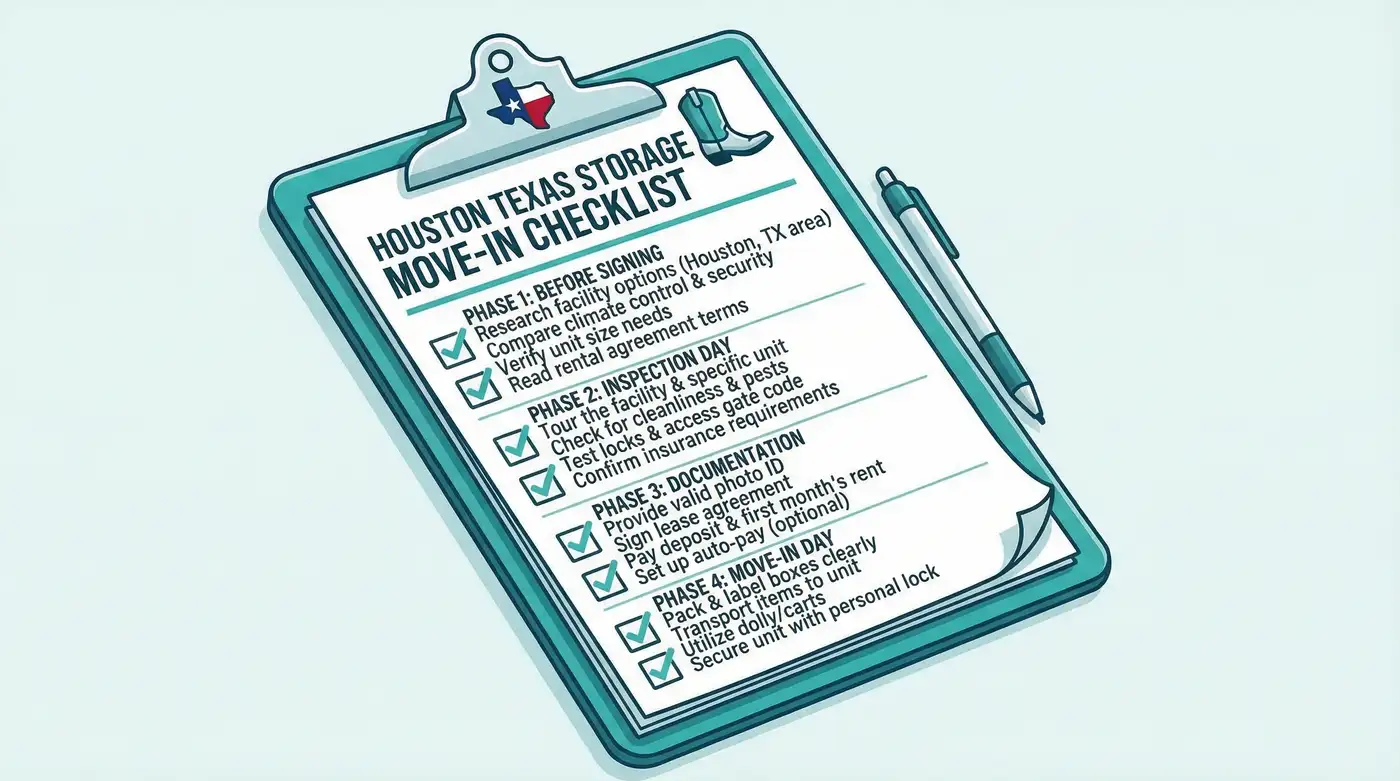
Houston Storage Unit Checklist: Before You Sign, Before You Move In
Renting a storage unit seems simple — until you discover rate increases, undisclosed flood risk, or damage from inadequate climate control. This four-phase checklist covers everything you need to verify before signing a lease, what to inspect during your tour, how to document your unit on move-in day, and your legal rights under Texas law if something goes wrong.
Phase 1: Before You Sign
Research & verification — do this from home before visiting
Phase 2: Touring the Facility
In-person inspection — bring your phone for photos
Phase 3: Move-In Day Documentation
Create your evidence file — this protects you in disputes
Phase 4: Know Your Rights & Protect Yourself
Texas law and your options if something goes wrong
Houston-Specific Storage Warnings
- ! Flood zone verification is essential. Houston has no zoning laws, and storage facilities can be built in flood-prone areas. Check the FEMA flood map yourself — do not rely solely on the facility’s answer.
- ! Harvey history matters. Any facility that flooded during Hurricane Harvey (August 2017) and has not made substantial structural changes remains at elevated risk. Ask directly and verify with neighbors or online records.
- ! Climate control claims vary wildly. “Climate-controlled” in Houston can mean anything from a full HVAC + dehumidification system to a window AC unit. Use our 5-step verification process before trusting the label.
- ! Standard policies rarely cover flood damage. Neither the facility’s tenant protection plan nor your homeowner’s/renter’s policy typically covers flood damage to stored items. If your unit is in a flood-prone area, ask about separate flood coverage.
- ! Summer move-in timing: If loading your unit in June through September, start early morning. Metal unit interiors can exceed 120°F by midday, creating heat exhaustion risk and potential damage to heat-sensitive items during the loading process.
Houston Storage Checklist FAQs
Frequently Asked Questions
What should I ask before signing a Houston storage lease?
Ask for the street rate (not the promotional rate), the facility's rate increase history over the past 2-3 years, the FEMA flood zone designation, whether climate control includes dehumidification, whether individual units have alarms, and request the full lease agreement by email before visiting so you can review it at home without sales pressure.
What are my rights under Texas storage lien law?
Under the Texas Property Code, a storage facility must send you a written notice at least 14 days before auctioning your belongings for non-payment. The total process from first missed payment to auction typically takes 4–6 weeks. You can stop the auction by paying the full amount owed at any time before the auction begins. If the auction generates more money than you owe, you have 2 years to claim the excess proceeds.
Does my homeowner's or renter's insurance cover items in storage?
Many homeowner's and renter's insurance policies extend coverage to items stored off-premises, typically at 10% of your personal property coverage limit. However, flood damage is almost never covered under standard policies. Check with your insurer before relying on this coverage, and ask about any exclusions for storage facility locations.
Do I need to buy the storage facility's insurance?
Most facilities require proof of insurance coverage. You can either purchase their tenant protection plan ($10-$20 per month) or provide proof of your own homeowner's or renter's policy. Your existing policy is almost always cheaper and provides better coverage. Bring your insurance declaration page when signing the lease.
What protections do military members have for storage units in Texas?
Active-duty military members are protected under the Servicemembers Civil Relief Act (SCRA). This prevents storage facilities from auctioning your belongings while you are on active duty and for a period after deployment. You may also be able to terminate a lease early without penalty if you receive deployment or PCS orders.
Related Houston Storage Guides
Storage Cost Guide
Complete pricing for every unit size, standard vs climate-controlled rates, and seasonal pricing patterns.
Climate Control Guide
Do you actually need climate-controlled storage in Houston? What the terms mean and what humidity destroys.
Neighborhood Guide
Storage pricing, availability, and flood risk for every major Houston neighborhood and suburb.
Sources & References (4)
- [1]Self Storage Association— Industry standards and unit sizing
- [2]Better Business Bureau— Business ratings and complaint history
- [3]NOAA Climate Data— Temperature and humidity data for climate-controlled storage guidance
- [4]Texas Secretary of State— Business entity verification
Reviewed by RelocateMeTX Editorial Team
Content verified March 2026. Relocation information on this page has been reviewed for accuracy against primary sources — see how we verify our data. This guide is for informational purposes only and does not constitute professional financial, legal, or medical advice.