
East Austin is the best neighborhood in Austin for young professionals in 2026. Walk Score of 84, one-bedroom rents starting under $1,000, and the densest concentration of live music, taquerias, and coffee-shop coworking spots in the city. But it’s not the only strong pick. Here are seven Austin neighborhoods ranked by the things that actually move the needle when you’re building a career: rent, walkability, commute time to major employers, and whether you’ll actually enjoy living there on a Tuesday night.
One thing still working in your favor: Austin rents have not recovered. The median lease signed inside the City of Austin in August 2026 was $2,200 a month, 4.3% lower than a year earlier, per the August 2026 Central Texas Housing Report from Unlock MLS, the Austin Board of Realtors’ MLS. The glut is shrinking, though: active lease listings in the city were down 28.8% on the year, so negotiate, but expect less room than a year ago.
How We Ranked These 7 Neighborhoods
We scored each neighborhood on five criteria that matter most to young professionals making a real move decision: monthly rent for a one-bedroom apartment, Walk Score (from walkscore.com), commute time to both downtown and the North Austin tech corridor, density of dining and nightlife within walking distance, and honest downsides that could be dealbreakers.
All rent data reflects February through March 2026 averages from RentCafe and Zumper. Home prices come from the Austin Board of Realtors. For a full breakdown of Austin’s neighborhoods beyond this list, see the Austin neighborhoods guide.
East Austin — The Creative Hub That’s Still Worth the Price
East Austin is where Austin’s creative energy lives in 2026. Walk Score: 84. One-bedroom rents range from $999 to $1,800 depending on proximity to East 6th Street, and median home prices push past $450,000 for single-family houses. The neighborhood sits just across I-35 from downtown, putting you 10 to 15 minutes from most central Austin offices.
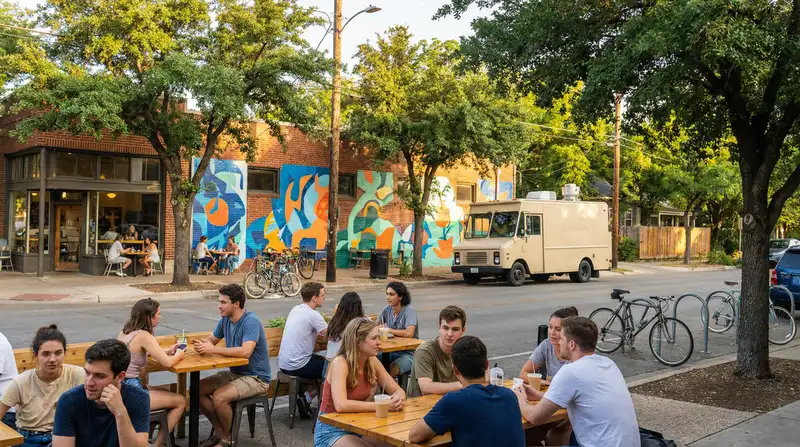
East 6th Street has the dive bars and live music venues. East Cesar Chavez has the taquerias, craft breweries like Lazarus Brewing, and restaurants like Suerte that pull diners from across the city. Coffee shops here double as coworking spaces where freelancers and startup founders park their laptops from 8am to 2pm. The Austin Bouldering Project gives you a gym option that feels more East Austin than a chain fitness center.
The trade-off is real, though. East Austin is gentrifying fast, and the artists and musicians who made the neighborhood cool are getting priced out. Parking is scarce on weekends. East 6th Street gets loud after 10pm on Thursdays through Saturdays.
- Walk Score 84, second highest on this list
- 1BR rents start under $1,000 in pockets
- Densest nightlife and dining outside downtown
- 10-15 min commute to downtown offices
- Weekend noise near East 6th (loud after 10pm)
- Street parking is a fight on weekends
- Gentrification is raising prices fast
- Median home price above $450K
Not for you if: you need quiet after 10pm, a private garage, or a brand-new apartment complex with a pool. East Austin’s charm is its grit, and that means older buildings and some street noise. Check out Austin’s arts and culture scene for more on the creative side of this neighborhood.
Downtown Austin — Walk-to-Everything Living at a Premium
Downtown Austin is the only neighborhood in this city where not owning a car is genuinely feasible. Walk Score: 90. Bike Score: 90. Transit Score: 69. One-bedroom rents run $2,350 to $3,327, making it the most expensive option on this list by a wide margin.
The upside of that price tag is proximity to everything. Tech startups, law firms, state government offices, and co-working spaces are all within walking distance. Sixth Street nightlife is at your doorstep. The hike-and-bike trail along Lady Bird Lake starts at the edge of downtown. You can get from your apartment to a barstool at Rainey Street in 10 minutes on foot.
The catch: it’s expensive, it’s loud, and the streetscape is heavy on concrete. Green space is limited to the lakefront trail and Republic Square. Rainey Street has converted bungalow bars that are fun on a Friday but noisy if you live next door. If you work in the Domain tech corridor (Apple, Amazon, IBM), your commute jumps to 35 to 45 minutes during rush hour.
- Walk Score 90, Bike Score 90, Transit Score 69
- Only area where carless living works
- Sixth Street, Rainey Street, Lady Bird Lake trail
- Walking distance to tech, law, and government offices
- Most expensive: $2,350 to $3,327 for a 1BR
- Loud on weekends (Sixth Street, Rainey Street)
- Limited green space, heavy concrete
- 35-45 min rush hour commute to Domain/Parmer
Not for you if: your budget is under $2,000/mo, you work on Parmer Lane, or you want a yard. Downtown is vertical living with an urban price tag.
South Congress (SoCo) — Austin’s Most Walkable Street
South Congress has the highest Walk Score on this list at 95 (a Walker’s Paradise rating per walkscore.com at the South Congress and Annie Street intersection) and it’s the stretch of Austin that most people picture when they imagine the city. One-bedroom rents average around $1,560, with the median home price above $500,000. The commute to downtown is 10 to 15 minutes by car or bike.
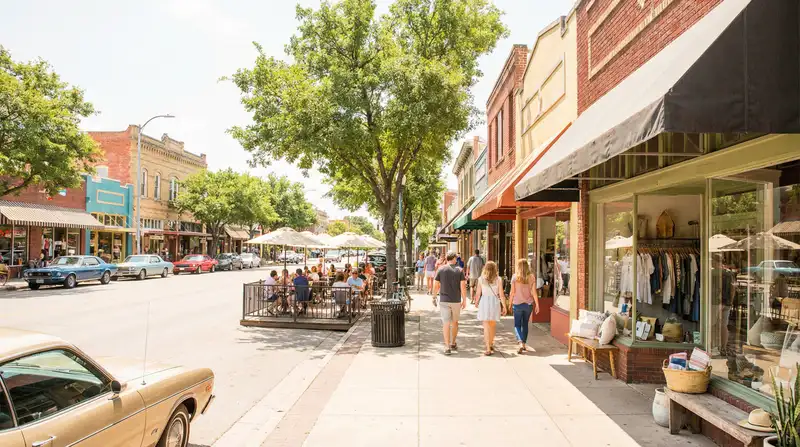
The boutiques, vintage shops, and restaurants along Congress Avenue have been Austin icons for decades. For young professionals, the appeal is walkability without the high-rise density of downtown. SoCo feels like a neighborhood, not a business district. You can bike across the Congress Avenue Bridge to downtown in under 10 minutes.
Here’s the long-game angle: SoCo sits directly on the planned Project Connect Orange Line light rail route. Construction is scheduled to begin in 2027, with service expected by 2033. A South Congress light rail stop would make this neighborhood accessible without a car from downtown, UT campus, and eventually the airport. Station-adjacent neighborhoods tend to appreciate faster once rail service opens, something worth considering if you’re thinking about buying here. For the full transit picture, see the Project Connect guide.
Not for you if: you hate tourist foot traffic on weekends, need a large apartment (housing stock is limited), or want a neighborhood that still feels like a local secret. SoCo is Austin’s postcard, and it draws crowds.
The Domain — Austin’s Tech Corridor Hub
The Domain is where Austin’s tech economy sleeps at night. One-bedroom rents run $1,410 to $1,761, and the area sits within 10 minutes of Apple’s Parmer Lane campus, Amazon’s Austin offices, and IBM’s North Austin facilities. If you work in Silicon Hills, this is the commute-optimized choice.
The Domain has luxury apartments, high-end retail, restaurants, and a nightlife scene that’s earned it the nickname “Austin’s second downtown.” For young professionals coming from cities like San Jose or Seattle, the format will feel familiar: mixed-use development, walkable within the complex, car-dependent outside it.
That’s the honest downside. The Domain is walkable inside its own bubble, but getting anywhere else in Austin requires a car. Downtown is 35 to 45 minutes in rush hour traffic. The MetroRail Red Line from Kramer Station offers a train option downtown (about 25 minutes), but the last train runs early. The vibe is corporate and polished. If you moved to Austin for the indie, keep-it-weird energy, the Domain will disappoint you.
- 5-10 min to Apple, Amazon, IBM campuses
- Luxury apartments with full amenities
- MetroRail Red Line to downtown (25 min)
- Dining, shopping, nightlife in one complex
- Car-dependent outside the Domain complex
- 35-45 min to downtown in rush hour
- Corporate feel, not "old Austin" character
- MetroRail runs limited evening hours
Not for you if: you want old Austin character, you don’t drive, or your social life is centered on East 6th Street. The Domain is for tech workers who prioritize commute and amenities over neighborhood soul.
Mueller — The Walkable Master Plan
Mueller is Austin’s answer to “what if we designed a neighborhood from scratch for walkability?” Built on the old Robert Mueller Municipal Airport site, this master-planned community has modern townhomes ($350,000 to $425,000 for the sweet spot), apartments, parks, trails, a weekend farmers market, and an Alamo Drafthouse — all within walking distance. It’s 10 to 15 minutes from downtown and close to the UT campus.
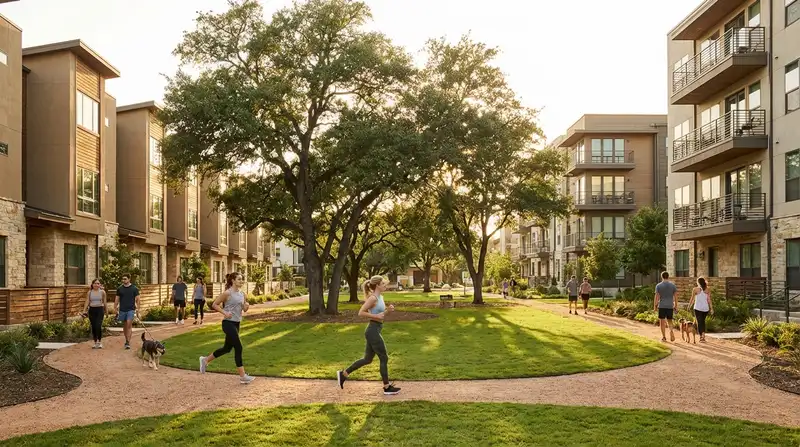
For remote workers or hybrid professionals, Mueller is a strong pick. The walkable town center means coffee runs, grocery trips, and lunch don’t require starting a car. The Thinkery children’s museum and Lake Park give the area a community-center feel that most Austin neighborhoods lack. Mueller is also close to Dell Seton Medical Center and several hospitals, making it convenient for healthcare workers.
The criticism you’ll hear: it feels too planned. Some locals call it “The Truman Show.” Everything is tidy, the architecture is uniform, and you won’t find the rough-edged charm of East Austin or the historical character of Hyde Park. Rental inventory is also limited compared to downtown or the Domain. If you’re looking for more outdoor recreation near Mueller, the nearby trails connect to the wider Austin greenway system.
Not for you if: you want grit, dive bars, or a neighborhood with 50 years of layered history. Mueller is polished by design.
North Loop + Hyde Park — Old Austin Character on a Budget
These two adjacent neighborhoods north of UT campus share a vibe: tree-lined streets, locally owned businesses, and the feeling that old Austin still lives here. Hyde Park has one-bedroom rents around $1,050 — the cheapest on this list — with median home prices between $400,000 and $475,000 and Walk Scores in the low 70s. North Loop runs $1,200 to $1,500 for a one-bedroom and is known for its record shops like Breakaway Records, its farmers market, and neighborhood bars like Workhorse Bar where the bartender recognizes you.
Both neighborhoods are bikeable to campus and downtown in about 15 minutes. Hyde Park has craftsman homes and giant pecan trees shading every block. North Loop has the vintage stores and coffee shops that East Austin had ten years ago, before the prices climbed.
The downsides: aging housing stock (expect older appliances and less insulation), limited nightlife compared to East Austin or downtown, and bus service that’s inconsistent. If you need a gym in your building or a concierge, you won’t find it here. These are neighborhoods for people who value character and low rent over amenities and new construction.
Not for you if: you want modern finishes, building amenities, or a quick drive to the Domain tech corridor (25 to 30 minutes in rush hour from Hyde Park).
Two More on Our Shortlist: South Lamar and Zilker
Our Austin shortlist for young professionals also names two neighborhoods this ranking doesn’t cover in depth. South Lamar is a central corridor that runs south from Lady Bird Lake toward Ben White Boulevard, with the Alamo Drafthouse and a long strip of restaurants on Lamar Boulevard, and a housing mix of newer apartment complexes, condos and older homes on the side streets. Zilker is built around Zilker Park, Barton Springs Pool and the Lady Bird Lake hike-and-bike trail; the Barton Creek corridor carries flood risk, so check the flood map for any address near the creek.
Quick Comparison: All 7 Neighborhoods Side by Side
| Neighborhood | 1BR Rent | Walk Score | Commute (Downtown) | Best For |
|---|---|---|---|---|
| East Austin | $999 – $1,800 | 84 | 10 – 15 min | Creative types, nightlife |
| Downtown | $2,350 – $3,327 | 90 | You're there | Carless living, networking |
| South Congress | ~$1,560 | 95 | 10 – 15 min | Walkability, Austin culture |
| The Domain | $1,410 – $1,761 | 72 (complex only) | 35 – 45 min (rush) | Tech workers (Apple, Amazon) |
| Mueller | $1,400 – $1,800 | 73 | 10 – 15 min | Walkable planned community |
| North Loop | $1,200 – $1,500 | 65 | 10 – 15 min | Budget + character |
| Hyde Park | ~$1,050 | 71 | 10 – 15 min | Lowest rent, old Austin charm |
How to Pick: Match Your Priority to a Neighborhood
Hyde Park ($1,050/mo) or North Loop ($1,200). Both are within biking distance of downtown and UT campus.
The Domain. 5–10 minute commute to Apple, Amazon, and IBM. Nothing else on this list comes close.
South Congress (Walk Score 95) or Downtown (90). SoCo is half the price of downtown.
East Austin. East 6th Street and East Cesar Chavez have the densest bar and restaurant scene outside downtown.
Mueller. Designed for walking-distance daily life, 10 min from downtown, and the quietest option on this list.
Use that framework as your starting point, then test-drive your top two picks with a short-term rental before signing a 12-month lease. In this market, you can negotiate. For a broader look at how Austin stacks up against Dallas and Houston for young careers, see our best Texas cities for young professionals guide.
Our affiliate, Furnished Apartments Dallas, quotes furnished stays in Austin by the night, week or month, priced by property and length of stay. Send your Austin dates for a quote while you get settled. Sponsored: RelocateMeTX is affiliated with F.A.D Furnished Apartments.
Ask About Austin Relocations →Frequently Asked Questions
What is the best area in Austin for young professionals?
It depends on your priority. If you want nightlife and walkability, East Austin (Walk Score 84) is the top pick with rents starting under $1,000. If you need a short commute to the Parmer Lane tech corridor, The Domain is 5 to 10 minutes from Apple and Amazon. For the tightest budget, Hyde Park at $1,050/mo is the lowest rent in central Austin. All three are within 15 minutes of downtown.
Is Austin good for young professionals in 2026?
Austin has over 5,000 open tech jobs, an average tech salary of $119,983, and no state income tax. Inside the city limits the median home sold for $560,000 in August 2026 (Unlock MLS), and the median lease was $2,200, 4.3% lower than a year earlier. The main barrier is cost of living. SmartAsset estimates a single person needs about $78,000 to cover basic expenses, while GOBankingRates puts the “comfortable” threshold at $122,875 using the 50/30/20 savings model. The gap between those two numbers is your buffer for dining out, travel, and retirement contributions.
What are the most affordable neighborhoods in Austin?
Within city limits, Riverside (one-bedroom from $941), North Lamar, Rundberg, and Windsor Park offer homes starting around $280,000. Near Austin, Pflugerville ($341,000 median), Manor ($333,000), and Kyle ($304,000) give you more house for the money, though commutes to downtown stretch past 30 minutes.
Is Austin cheaper than Dallas?
Not on housing. Austin’s median home price and one-bedroom rents both run above Dallas-Fort Worth’s, and that gap is most of what makes Austin feel expensive. Outside housing the two metros sit close together: BEA’s regional price parities put both within a few points of the national average of 100, so which one wins depends on your own spending mix. Both cities share the Texas no-income-tax advantage.
What is the safest neighborhood in Austin for young professionals?
Mueller, Hyde Park, and The Domain consistently rate among the safest neighborhoods for young professionals. Mueller’s master-planned design and Hyde Park’s established residential character keep crime rates low. The Domain benefits from private security and controlled-access apartment complexes.
How is Austin's rental market in 2026?
Still soft, but tightening. The median lease signed inside the City of Austin in August 2026 was $2,200 a month, 4.3% lower than a year earlier, while active lease listings fell 28.8% on the year, per the August 2026 Central Texas Housing Report from Unlock MLS. Landlords still negotiate on move-in specials, reduced deposits, and waived application fees. If you’re signing a lease in 2026, ask for concessions before you agree to the listed price.
If your priority is the cheapest rent with real neighborhood character, start with Hyde Park and North Loop. If you’re optimizing for a tech career commute, The Domain is the clear answer. And if you want the neighborhood that best captures what makes Austin different from Dallas or Houston (the murals, the music, the taco trucks), East Austin is where you should sign a lease. Start your Austin research with the full city guide and explore Austin’s food and dining scene to see what each neighborhood puts on the table.