
The best Dallas neighborhoods for remote workers in 2026 are Old East Dallas for value, Bishop Arts for budget-plus-lifestyle, and Uptown for networking, with Frisco the suburb pick. Three DFW suburbs rank in the national top 13 for remote work, and the Dallas metro has roughly 688,000 people working from home. But “best neighborhood” means something different when your commute is a hallway. Remote workers don’t need highway access or parking garage proximity. They need fast internet, walkable lunch spots, a quiet place to take calls, and a cost of living that doesn’t cancel out the no-state-income-tax advantage. Here are eight Dallas-area neighborhoods ranked by the things that actually matter when you work from home.
Why Dallas Keeps Pulling in Remote Workers
Dallas-Fort Worth is home to approximately 688,000 remote workers, and those workers earn a median income of $77,000, a 51% premium over the $51,100 median for all DFW workers (2023 figures), according to the U.S. Census Bureau American Community Survey.
That income gap is the engine. Remote workers earning coastal salaries in a city where the median sale price sits at $448,703 (City of Dallas, Redfin, August 2026) can build equity faster than in Austin, Denver, or any California market.
Texas has no state income tax. On a $90,000 salary, that saves roughly $4,500 compared to California or about $3,600 compared to Illinois. Property taxes are higher than the national average, and the number that matters depends on whether you rent or buy. If you buy inside the city of Dallas, the combined property-tax rate is about 2.23% of assessed value before exemptions (Dallas ISD + City + County + Parkland Hospital + Dallas College), which works out to roughly $8,900 a year on a $400,000 home before exemptions, per the Dallas County Tax Office. After you file the homestead exemption, a new owner’s effective rate is about 1.58%–1.74% (it varies with which local-option exemptions you claim), or roughly $6,300–$7,000 a year on that same $400,000 home. The county-wide average effective rate is lower, around 1.4%–1.5% (SmartAsset 1.41%, Ownwell 1.55%), because Texas’s 10% appraisal cap holds long-time owners’ assessed values below market — that is the steady-state county figure, not what a new buyer pays in year one. Either way, the net tax burden still favors Dallas for most remote workers earning above $65,000.
The job market helps too. DFW added 46,800 nonfarm payroll jobs in the year ending May 2025. For remote workers, that means a growing city with appreciating home values and a deep bench of hybrid-friendly employers if you ever want to go back to an office part-time.
For a full breakdown of fiber speeds, coworking spaces, and remote work stats, see our Dallas remote work guide.
RelocateMeTX is affiliated with F.A.D Furnished Apartments.
What to Prioritize When Your Office Is Your Apartment
Remote workers spend 8-10 hours a day in their neighborhood. That changes the priority list. Commute time to a downtown office drops to zero. What replaces it: daytime walkability, internet reliability, and whether there’s a decent coffee shop within a 10-minute walk.
Internet first. Fiber doesn’t reach every address. AT&T Fiber reaches 73.7% of the city (up to 5 Gbps symmetrical, from $35/month in September 2026). Frontier serves 2.5% with speeds up to 7 Gbps. Spectrum cable covers 92% with up to 1 Gbps (coverage figures: BroadbandNow, data as of September 29, 2026). The dead zones: downtown Dallas and parts of South Dallas have weaker fiber coverage.
Backup matters. Power outages and ISP downtime happen. T-Mobile 5G Home Internet runs $50/month as a secondary connection. Starlink offers a $5/month standby plan for dual-WAN failover.
Square footage counts. A dedicated room with a door beats a kitchen-counter setup by month three. Look at two-bedroom apartments even if you live alone, and factor the step-up into your housing math: about $500 a month across Dallas on Zumper’s September 2026 medians ($1,300 one-bedroom, $1,800 two-bedroom). Our Dallas housing overview compares rent by neighborhood and unit size.
5 Urban Neighborhoods That Actually Work for Remote Workers
Old East Dallas: Best Overall Value
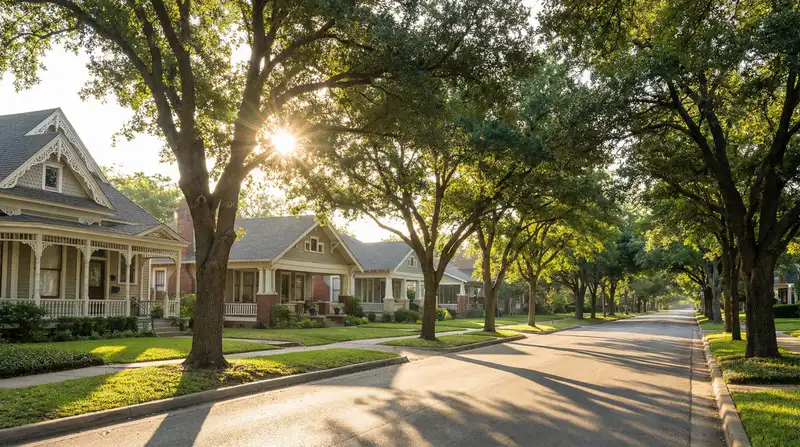
Old East Dallas is the neighborhood that remote workers keep recommending to other remote workers. Median rent sits at $1,350/month, the lowest of the eight picks here. The walk score of 62 won’t win awards, but it’s enough to reach a handful of coffee shops on foot, including spots along Swiss Avenue and Gaston Avenue where laptops are welcome all afternoon.
The housing stock is mostly historic — Victorian homes, Craftsman bungalows, and mid-century duplexes, which means rooms have actual walls and doors instead of open-plan loft layouts. That translates to better home-office acoustics on Zoom calls. AT&T Fiber covers the area well, with most addresses eligible for gigabit or faster.
The vibe is quiet and neighborly during work hours, with a creative undercurrent. You’re a 10-minute drive from Deep Ellum’s restaurants when the workday ends. Not for you if: you want nightlife on your doorstep, or you depend on DART rail for a hybrid commute.
Why Bishop Arts Works on a Budget
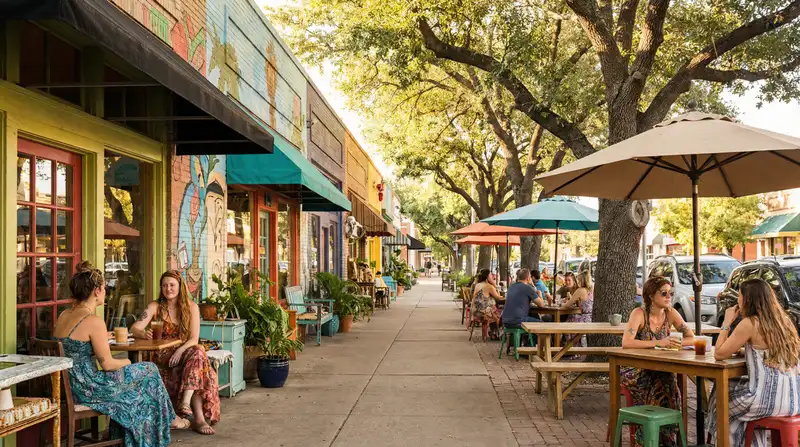
Bishop Arts packs a lot of personality into a small budget. At $1,400/month median rent, it undercuts most inner-city neighborhoods while offering a walk score of 75 and a concentration of independent shops, galleries, and restaurants that feel nothing like a chain-heavy suburb. Wild Detectives, a bookstore-coffee-shop-bar hybrid on Davis Street, is the unofficial remote-work headquarters of the neighborhood, open from 10 a.m. to midnight.
The DART Oak Cliff streetcar connects Bishop Arts to downtown for hybrid workers who need occasional office time. Median home prices around $320,000 make this one of the few in-city neighborhoods where a remote worker on a single income can realistically buy. The neighborhood is part of North Oak Cliff’s ongoing growth, with new restaurants and retail opening regularly.
Not for you if: you need major chain stores or big-box retail nearby. The independent-shop character is the whole point, and a Target run means driving 15 minutes north.
Lower Greenville for the Home-Office Purist
Lower Greenville is where you live if your ideal workday involves zero coworking spaces and one really good lunch spot within walking distance. The walk score of 78 gives you access to the restaurant row along Greenville Avenue between Mockingbird Lane and Ross Avenue — tacos, ramen, Thai, barbecue, all within a 10-minute stroll from most apartments in the area.
Median rent is $1,600/month. The housing mix leans toward older apartments and duplexes with separate rooms, which matters for home-office setups. AT&T Fiber and Frontier both have coverage here. The area is quieter than Uptown or Deep Ellum during the day, residential enough to concentrate but close enough to walk somewhere interesting when you need a break.
Lakewood and White Rock Lake are a short bike ride east, giving you a decompression route after work that doesn’t involve a car. Not for you if: you want a high-rise apartment or need easy DART rail access (the closest station is a 15-minute bus ride away).
Uptown: Where the Coworking Scene Lives
Uptown packs coworking spaces, rooftop bars, and young professionals into a few walkable blocks. If working remotely makes you feel isolated and you’d rather fix that with a walkable scene than a Slack channel, Uptown delivers. Walk Score: 87 (Walk Score, ZIP 75201). Transit score: 58.
The tradeoff is cost. Median rent hits $2,100/month, and you’re paying for the location premium. Coworking options include Good Coworking and several WeWork-affiliated spaces, running $250-400/month for a hot desk. Fount Board and Table in the West Village area doubles as a coffee shop and informal workspace.
The Katy Trail, a 3.5-mile rail-to-trail path, runs through the neighborhood and is packed with runners and walkers from 6 a.m. on, giving you a built-in before-work routine. McKinney Avenue has the restaurants and bars. Not for you if: you’re on a tight budget or need quiet streets after 9 p.m.
- Walk Score 87 (ZIP 75201), highest of the eight picks
- Dense coworking options
- Katy Trail for morning runs
- Built-in social and networking scene
- $2,100/mo median rent (priciest pick)
- Noisy during evenings and weekends
- Parking is expensive ($150+/mo garage)
Deep Ellum: The Freelancer’s Pick
Deep Ellum attracts freelancers, designers, and startup founders who want a neighborhood with a pulse. Median rent runs $1,750/month, and the housing stock is mostly loft-style apartments in converted warehouses. Walk score: 82. The DART Green Line runs through the neighborhood, connecting you to downtown in under 10 minutes.
GeniusDen coworking is the local anchor, and Common Desk has a location nearby. Murray Street Coffee, tucked on the eastern edge of the district, is a favorite low-key work spot. The murals, live-music venues, and gallery openings give the area a creative charge that some people find motivating and others find distracting.
Here’s what most guides won’t tell you: Deep Ellum has a different personality at 2 p.m. than at 2 a.m. During work hours, it’s quiet, walkable, and dotted with open laptops in coffee shops. After dark, the bars and music venues turn the volume up. Not for you if: you’re a light sleeper, have small kids, or need Zoom-friendly acoustics in an open loft.
- Walk score 82, DART Green Line access
- Creative energy and coworking options
- Loft-style apartments with character
- Murray Street Coffee for daytime work
- Loud after dark (light sleepers beware)
- Loft acoustics can be rough on Zoom
- Not family-friendly
3 Suburbs That Top the National Remote-Work Rankings
Frisco, McKinney, and Addison aren’t inside Dallas city limits, but remote workers flock to all three for different reasons.
Frisco has the highest remote-work share of the large U.S. cities SmartAsset ranked, with 33.7% of its workforce (roughly 42,133 people) working from home, according to SmartAsset’s 2026 study of 2024 Census data; it also led the 2025 edition. AT&T Fiber covers 84.6% of the city (BroadbandNow, September 2026). The median home value of $642,100 (U.S. Census, ACS 2020-2024) is steep, but the homes are large and new, often with dedicated office space already built in. The catch: car-dependent for everything.
McKinney is the better-value alternative at a $471,800 median home value (same Census series), and it ranks seventh in the same SmartAsset study at 26.7%. Its historic downtown square has independent coffee shops and a walkable core that Frisco lacks. Remote work prevalence rose from 24.2% to 26.7% year-over-year.
Addison splits the difference: suburban convenience at urban prices ($1,500/month rent, $350,000 median home). Its small residential base (population ~16,000) sits next to a long restaurant corridor. Addison sits directly on the DART Silver Line, which opened in October 2025 and connects to DFW Airport. For remote workers who fly frequently for client meetings, that airport link matters.
Explore all DFW suburban options in our full Dallas neighborhoods guide.
All 8 Neighborhoods at a Glance
| Neighborhood | Type | Median Rent | Walk Score | Fiber ISPs* | Top Fiber Speed* | Coworking Nearby | Best For |
|---|---|---|---|---|---|---|---|
| Old East Dallas | Urban | $1,350/mo | 62 | AT&T Fiber | Up to 5 Gbps | Caddo (Lakewood) | Best overall value |
| Bishop Arts | Urban | $1,400/mo | 75 | AT&T Fiber | Up to 5 Gbps | Switchyards (Oak Cliff) | Best on a budget |
| Lower Greenville | Urban | $1,600/mo | 78 | AT&T Fiber | Up to 5 Gbps | Common Desk Energy Square (2 mi) | Home-office workers |
| Deep Ellum | Urban | $1,750/mo | 82 | AT&T Fiber | Up to 5 Gbps | Spaces (Pacific Ave) | Creatives and freelancers |
| Uptown | Urban | $2,350/mo (1BR) | 87 | AT&T Fiber | Up to 5 Gbps | WeWork (McKinney Ave) | Networking and social energy |
| Addison | Suburb | $1,500/mo | 55 | AT&T + Frontier | Up to 7 Gbps | Apt CoWork (Savoye) | Dining + DART Silver Line |
| McKinney | Suburb | $507K home | 27 | AT&T Fiber | Up to 5 Gbps | Enclave on the Square | Better value, walkable downtown |
| Frisco | Suburb | $671K home | 26 | AT&T + Frontier | Up to 7 Gbps | Caddo (Main St) | Highest remote-work share, SmartAsset 2026 (33.7%) |
*Fiber availability is address-level. ISP columns reflect each provider's own city coverage pages as of June 2026; always confirm at your exact address. Top Fiber Speed shows the fastest residential tier the listed provider advertises (AT&T Fiber up to 5 Gbps, Frontier up to 7 Gbps); the speed actually available is address-level. Google Fiber serves no DFW city (its Texas markets are Austin and San Antonio). Coworking names were checked against operator location pages in June 2026. Rents re-checked June 2026 against RentCafe market data; the Uptown figure is the one-bedroom average.
Internet and Coworking: The Two Non-Negotiables

Fiber internet and coworking access make or break a remote-work neighborhood. Dallas scores well on both, but coverage is uneven.
AT&T Fiber (up to 5 Gbps) covers the north and east sides of Dallas strongest, including Uptown, Lakewood, Lower Greenville, and Far North Dallas. Frontier Fiber (up to 7 Gbps) is strongest in Plano and parts of northwest Dallas. Spectrum cable fills the gaps at up to 1 Gbps. One assumption to drop before you sign a lease: Google Fiber does not serve Dallas or any DFW city — as of mid-2026 its only Texas markets are Austin and San Antonio, so AT&T and Frontier are the fiber decision here.
For coworking, expect to spend $150-400/month depending on the setup:
- Common Desk (a WeWork company): Dallas locations include Energy Square on Greenville Avenue; shared desks start around $150/month. Its Deep Ellum location has closed, so check the current list at commondesk.com before committing.
- Switchyards in Oak Cliff (610 N Tyler St): a neighborhood work club a short walk from Bishop Arts, built for laptop work rather than private offices.
- Capital Factory in Oak Lawn, tech-focused, strong for startup networking.
- The Cue at 10000 North Central Expressway, panoramic views, dedicated phone booths, standing desks.
- CoWork and Coffee on the LBJ Freeway corridor, exactly what the name says, built for remote workers who want coffee and Wi-Fi without a long-term lease.
If you need a furnished apartment in Dallas with a move-in-ready home office while you search for a permanent spot, short-term corporate housing gives you fiber internet and furniture from day one. RelocateMeTX is affiliated with F.A.D Furnished Apartments.
How to Match Your Work Style to a Neighborhood
The right neighborhood depends on how you actually work, not just where you want to live.
| Work Style | Best Neighborhoods | Key Reason |
|---|---|---|
| Full-time remote | Lower Greenville, Old East Dallas | Quiet streets, separate-room apartments, solid fiber |
| Remote + social | Uptown, Deep Ellum | Coworking density, built-in social scene |
| Hybrid (1-2 days office) | Addison, Bishop Arts | DART Silver Line / streetcar access |
| Remote + family | Frisco, McKinney | Top school districts, large homes with offices |
Full-time remote, mostly from home: Lower Greenville or Old East Dallas. Quiet residential streets, separate-room apartments, solid fiber, walkable food options for midday breaks. You don’t need coworking density if your home setup is dialed in.
Remote but social, coworking 2-3 days a week: Uptown or Deep Ellum. High coworking density, walk-to-everything culture, built-in social scene. You’ll pay more for rent, but you’ll spend less time feeling isolated, which is the main reason remote workers go back to offices.
Hybrid, remote most days, office 1-2 days a week: Addison (DART Silver Line access) or Bishop Arts (DART streetcar to downtown). Transit proximity matters when you have occasional in-person commitments. Check the DART-commutable neighborhoods guide for more options.
Remote with a family: Frisco or McKinney. Top-rated school districts, large homes with office space, strong fiber. Trade walkability for square footage and school quality. Our family-friendly neighborhoods list breaks down the school district differences.
Three Renter Situations the Rankings Miss
Two people, two laptops, one apartment. A one-bedroom doesn’t survive two simultaneous video calls. The math that matters is the two-bedroom step-up: across the city of Dallas it’s about $500 a month on Zumper’s September 2026 medians ($1,300 for a one-bedroom, $1,800 for a two-bedroom), cheap for what is effectively a second office. If you both take heavy call loads, Old East Dallas’s older fourplexes and Addison’s larger floor plans are the picks on this list most likely to buy you a closable door each.
The midday-escape test. Eight hours at home makes the third-place question (where do you go at 12:30?) a daily quality-of-life issue. Uptown renters get the Katy Trail out the front door; Old East Dallas and Lower Greenville sit minutes from White Rock Lake’s 9-mile loop; Bishop Arts has walkable streets but little green space. If a midday run or walk is non-negotiable, weight Uptown and the White Rock-adjacent picks over Deep Ellum.
Try a neighborhood before you commit to it. A 12-month lease in the wrong neighborhood is the most expensive mistake on this page. Short-stay furnished rentals exist across these eight areas and let you test a commute-free routine before signing; our Dallas furnished housing guide covers how that market works and what it costs.
Finding a Work-From-Home Rental in Dallas
Best apartments for working from home in Dallas
Look for a second bedroom or at least a room with a door, not an open loft. The older apartments, duplexes and fourplexes in Lower Greenville ($1,600 median rent) and Old East Dallas ($1,350) are the picks on this list most likely to give you one. The two-bedroom step-up across the city is about $500 a month on Zumper’s September 2026 medians ($1,300 to $1,800), and it buys you a real office.
Where to find a rental with good wifi in Dallas
AT&T Fiber is strongest on the north and east sides, including Uptown, Lakewood, Lower Greenville and Far North Dallas. Frontier Fiber is strongest in Plano and parts of northwest Dallas. Downtown and parts of South Dallas have the thinnest fiber, so check the unit’s exact address at broadbandmap.fcc.gov before you sign.
What to look for in a work-from-anywhere rental
Four things: fiber confirmed at the unit’s address, a backup connection (T-Mobile 5G Home Internet at $50 a month or Starlink standby at $5), a room with a door for calls, and a coffee shop or lunch spot within a 10-minute walk. A month-to-month furnished rental lets you test all four before you commit to a 12-month lease.
Popular neighborhoods for remote workers
In the suburbs the numbers are clearest: Frisco (33.7%), McKinney (26.7%) and Allen all sit in SmartAsset’s 2026 national top 13 for remote-work share. Inside the city, Uptown draws the coworking crowd, Deep Ellum the freelancers, and Old East Dallas and Lower Greenville the people who work from a home office every day.
Ready to start comparing costs? The Dallas moving guide covers everything from apartment hunting timelines to Texas driver’s license deadlines. For the broader picture of what life in Dallas looks like — job market, cost of living, culture, weather, and pros and cons — see our complete guide to living in Dallas, Texas.
Frequently Asked Questions
Is Dallas affordable for remote workers in 2026?
Yes, especially compared to coastal metros. The city of Dallas median sale price is $448,703 (Redfin, August 2026), and median one-bedroom rents range from $1,350 in Old East Dallas to $2,100 in Uptown. Texas has no state income tax, which saves a remote worker earning $90,000 roughly $3,600-4,500 per year compared to Illinois or California. For a buyer, the city of Dallas combined property-tax rate is about 2.23% of assessed value before exemptions, dropping to a 1.58%–1.74% effective rate after the homestead exemption (the county-wide average effective rate is lower, around 1.4%–1.5%). The net tax burden still favors Dallas for most earners above $65,000.
What is the best internet provider in Dallas for working from home?
AT&T Fiber is the most widely available fiber option, covering 73.7% of Dallas (BroadbandNow, data as of September 29, 2026) with symmetrical speeds up to 5 Gbps, from $35/month in September 2026. Frontier Fiber offers faster top speeds (7 Gbps) but covers only 2.5% of the city on the same data; it’s far stronger in Plano. Spectrum cable (up to 1 Gbps) covers 92% as a reliable backup. Check your exact address at broadbandmap.fcc.gov before signing a lease. Fiber availability varies block by block.
Do remote workers in Dallas earn more than commuters?
Significantly more. U.S. Census Bureau survey data for 2023 put the median earnings of DFW remote workers at $77,000, against $51,100 for all DFW workers, a 51% premium. This reflects the concentration of tech, finance, and professional services roles in the remote workforce, not a direct pay bump for working from home.
Is McKinney or Frisco better for remote workers?
McKinney offers better value: a $471,800 median home value versus Frisco’s $642,100 (U.S. Census, ACS 2020-2024), a walkable historic downtown with independent coffee shops, and a remote work rate that jumped from 24.2% to 26.7% year-over-year. Frisco has more retail, dining, and slightly better fiber coverage (AT&T Fiber at 84.6% of Frisco, BroadbandNow, September 2026). Both have top-rated school districts. Choose McKinney for charm and savings, Frisco for newer construction and corporate convenience.
When is the best time to find an apartment in Dallas?
November through February. Peak rental season (May through August) means more available units but higher prices and more competition. Off-season renters often get better lease terms, lower deposits, and landlords willing to negotiate on rent. If you’re relocating from out of state, the cooler winter months also spare you from apartment-hunting in 100-degree heat.
Which DFW neighborhoods have the fastest fiber internet?
Plano has Frontier Fiber offering up to 7 Gbps symmetrical speeds covering approximately 81% of the city. AT&T Fiber, at up to 5 Gbps symmetrical, reaches 84.6% of Frisco, 80.8% of Richardson and 74.4% of Allen (BroadbandNow, September 2026). Inside Dallas proper, Uptown, Lakewood, Lower Greenville, and Oak Cliff have the strongest AT&T Fiber coverage. Southern Dallas and parts of downtown have weaker fiber availability, so always verify at your specific address before committing.
Related Dallas Resources
- Dallas Remote Work Guide — best DFW cities for WFH, with coworking and infrastructure details
- What Salary You Need to Live in Dallas — income math for renters and buyers
- Cost of Living in Dallas by Neighborhood — full neighborhood cost breakdown
- All Dallas Neighborhoods — compare 35+ areas by lifestyle and budget
- Moving to Dallas Checklist — 90-day operational plan
- Dallas City Guide — daily life in DFW